How to Optimize Your Studio Website for More Bookings

TL;DR:
- Optimizing a tattoo studio website improves speed, messaging, and user experience to attract and convert clients.
- A fast, clear, mobile-friendly site with storytelling portfolios significantly increases bookings and reduces inquiries.
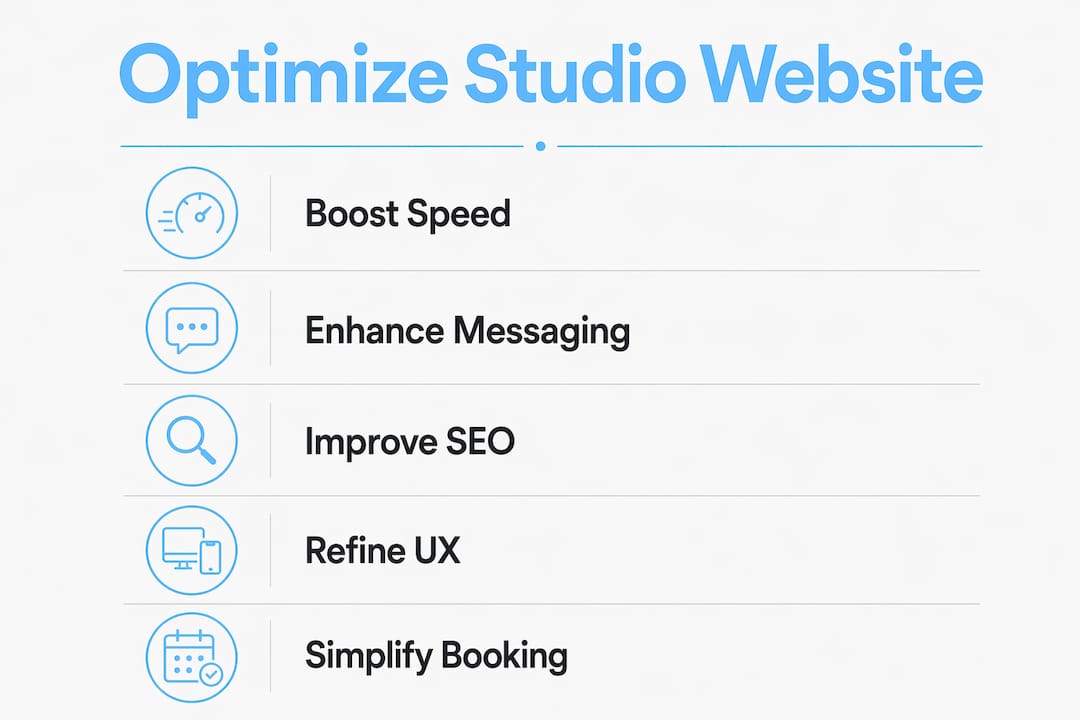
Studio website optimization is the process of improving your site’s speed, usability, messaging, SEO, and conversion tools to turn visitors into paying clients. For tattoo studios, your website is not a digital flyer. It is your most active sales tool, working around the clock to attract, qualify, and convert new clients. Mobile traffic now exceeds 65% of all website visits, which means a slow or poorly structured site is actively costing you bookings. Knowing how to optimize your studio website gives you a measurable edge over studios that treat their site as an afterthought.
How to enhance your studio website’s speed and performance
Site speed is the foundation of every other optimization effort. A visitor who waits more than two or three seconds for your page to load will leave before they ever see your portfolio. A one-second delay in page load time reduces conversions by 7%. For a studio booking ten clients a week, that adds up to real lost revenue fast.
Image formats and compression
Images are the biggest performance culprit on tattoo studio websites. Your portfolio is image-heavy by nature, so format choices matter enormously. WebP image files are up to 30% smaller than JPEGs at the same visual quality. Switch every portfolio image to WebP or AVIF format and compress aggressively before uploading. Pair this with lazy loading so offscreen images only load when a visitor scrolls toward them.

Hosting, caching, and delivery
Your hosting provider sets the ceiling for your site’s speed. Choose managed hosting that supports HTTP/3, PHP 8.x, and server-side caching. A Content Delivery Network (CDN) stores cached copies of your site on servers worldwide, so a client in Austin and a client in Seattle both get fast load times. CDNs are not just for large businesses. They are affordable and effective for single-location studios.
Code and script management
Script bloat harms your INP score, which measures how quickly your site responds to a user’s click or tap. Load only the scripts your site genuinely needs and defer everything else. Minify your CSS and JavaScript files, remove unused plugins, and audit your database regularly to clear out junk that slows queries. Font optimization also matters. Use WOFF2 format and set font-display: swap so text renders immediately while custom fonts load in the background.
Pro Tip: Run your site through Google PageSpeed Insights once a month. Focus on the three Core Web Vitals scores: Largest Contentful Paint (LCP), Cumulative Layout Shift (CLS), and Interaction to Next Paint (INP). These are the metrics Google uses to rank your site.
| Performance area | Recommended action | Impact |
|---|---|---|
| Image format | Convert to WebP or AVIF | Up to 30% smaller files |
| Script management | Defer non-critical JavaScript | Improves INP score |
| Hosting | Use managed hosting with CDN | Faster global load times |
| Fonts | Use WOFF2 with font-display swap | Eliminates invisible text flash |
| Broken links | Crawl and fix 404 errors regularly | Reduces server load and improves UX |
Fixing broken links reduces unnecessary server requests and keeps visitors from hitting dead ends. Schedule a monthly crawl using a tool like Screaming Frog or Sitebulb to catch and fix 404 errors before they hurt your rankings.
What messaging and content strategies convert visitors into clients?
Studios that treat their website as a sales funnel rather than a portfolio gallery book more clients and field fewer low-quality inquiries. The difference is messaging clarity. Your homepage needs to communicate exactly who you serve, what styles you specialize in, and what a client should do next. Vague taglines like “Where art meets skin” tell a visitor nothing. Specific messaging like “Custom Japanese and blackwork tattoos in Denver, CO. Book your consultation today” does the work.
Lead with benefits, not credentials
Most studio websites open with the studio’s history or awards. Clients do not care about that first. They care about whether you can give them the tattoo they want. Lead every page with the outcome you deliver, then support it with your credentials and experience. Add qualifying subheadlines that filter inquiries naturally. A line like “We specialize in large-scale custom work. Minimum booking is $500” saves you and the client time.
Use storytelling portfolios
Narrative-driven case studies that show the challenge, the process, and the finished result build trust faster than a gallery of finished photos alone. A page that shows a client’s reference image, the artist’s sketch, a mid-session photo, and the healed result answers every question a prospective client has before they even reach out. This approach shortens your sales cycle and reduces repetitive inquiry emails.
Here is a numbered framework for building a storytelling portfolio page:
- Show the starting point. Include the client’s reference or inspiration image.
- Explain your process. Describe how you developed the design concept.
- Document the session. Add one or two in-progress photos.
- Reveal the result. Use a high-quality photo of the finished, healed tattoo.
- Add a client quote. A short testimonial on the same page closes the trust loop.
Calls to action and contact forms
Your call to action (CTA) must be visible at all times on mobile. A sticky header or floating button that says “Book a Consultation” keeps the next step in front of every visitor. Simplify your contact form to three or four fields. Ask for name, email, style preference, and approximate budget. Conditional logic on your forms filters low-value inquiries by showing or hiding fields based on previous answers. A client who selects “small walk-in” sees different follow-up questions than one who selects “full sleeve custom work.”
Pro Tip: Add a line near your booking form that sets expectations: “We respond to all inquiries within 48 hours.” This small detail reduces follow-up emails and builds immediate trust.
How to use SEO to attract the right clients to your studio
SEO for tattoo studios is not about ranking for “tattoo.” That keyword is too broad and too competitive to win. Intent-focused, long-tail keywords like “custom blackwork tattoo artist in Chicago” or “fine line tattoo studio near me” attract visitors who are ready to book, not just browse. These are the searches that convert. Building your tattoo studio brand around a clear specialty makes keyword targeting easier and more effective.
On-page SEO essentials
Every image in your portfolio needs descriptive ALT text. “Tattoo-1.jpg” tells Google nothing. “Traditional Japanese koi sleeve tattoo by artist name, Austin TX” tells Google exactly what the image shows and where you are. Schema markup for services, testimonials, and FAQs helps search engines display rich results, which increases click-through rates from search pages. SEO-friendly URL structures and clear navigation also help Google generate sitelinks, the additional links that appear under your main result in search.
Local SEO and landing pages
Build a dedicated landing page for each location or neighborhood you serve. A page titled “Tattoo Studio in East Nashville” with genuine local references, nearby landmarks, and neighborhood-specific content ranks far better than a generic “Contact Us” page. Link your Google Business Profile directly to these pages. Consistent name, address, and phone number (NAP) data across your site and all directories is a basic but frequently missed local SEO requirement.
| SEO tactic | What it does | Priority |
|---|---|---|
| Long-tail keyword targeting | Attracts high-intent, ready-to-book visitors | High |
| Descriptive image ALT text | Improves image search and AI visibility | High |
| Schema markup | Enables rich results in search | Medium |
| Local landing pages | Ranks for neighborhood-specific searches | High |
| Internal linking | Builds topical relevance across pages | Medium |
Regular content updates like blog posts, behind-the-scenes articles, and new case studies signal to search engines that your site is active and authoritative. A studio that publishes one new piece of content per month builds compounding SEO value over time. Interlink your portfolio pages with related blog content to create topical clusters that search engines reward with higher rankings. Your studio appointment lifecycle is also worth documenting in a blog post. It answers common client questions and builds organic traffic from people researching the booking process.
How to improve UX and contact forms for better client engagement
User experience (UX) is the measure of how easy and pleasant your site is to use. For tattoo studios, good UX means a prospective client can find your portfolio, understand your specialty, and submit an inquiry in under three clicks. Mobile-first design is the starting point. Over 65% of your visitors arrive on a phone, so every button, form field, and image must work perfectly on a small screen.
Reducing friction in the booking path
Every extra step between “I found this studio” and “I submitted an inquiry” costs you clients. Keep navigation simple. Your main menu should have five items or fewer. Your contact or booking page should be reachable in one click from anywhere on the site. Pre-qualify visitors with a short intro on your booking page that describes your minimum project size, your specialties, and your typical timeline. This filters out poor-fit inquiries before they reach your inbox.
Trust signals on contact pages
Place testimonials, healed photo galleries, and expected response times directly on your contact page. Most studios put social proof only on their homepage. Putting it at the point of conversion, right next to the form, reinforces the decision a visitor is about to make. Accreditations, press mentions, and years in business also work as trust signals. A visitor who sees “Featured in Inked Magazine” next to your booking form feels more confident hitting submit.
Pro Tip: Test your contact form on three different phones before launching any new page. What looks clean on a desktop often has overlapping fields or tiny tap targets on a phone screen.
Showing the tattoo process from consultation through healed result acts as a pre-sell. It answers the questions a nervous first-time client would ask before they even think to ask them. This reduces the back-and-forth email chains that eat up your time and slow down the booking process. A well-structured process page also supports your booking follow-up workflow, since clients who understand the process need less hand-holding after they submit an inquiry.
- Use touch-friendly buttons with at least 44px tap targets on mobile.
- Limit contact forms to four fields maximum for first contact.
- Add conditional logic to show relevant follow-up questions based on the client’s style selection.
- Display your response time expectation clearly near the submit button.
- Test CLS and INP scores after any design change to catch layout shifts that frustrate mobile users.
Key Takeaways
A fast, well-messaged, and mobile-ready studio website is the single most effective tool for converting online visitors into booked tattoo clients.
| Point | Details |
|---|---|
| Speed is non-negotiable | A one-second delay cuts conversions by 7%; compress images and defer scripts immediately. |
| Messaging drives bookings | Clear, specific copy about your specialty and location converts better than vague taglines. |
| SEO targets intent, not volume | Long-tail, location-specific keywords attract clients who are ready to book, not just browse. |
| UX reduces drop-off | Three-click access to booking and mobile-first forms keep visitors moving toward inquiry. |
| Storytelling builds trust | Portfolio pages that show process and results pre-sell clients before they reach out. |
Why most studio websites leave money on the table
I have reviewed a lot of tattoo studio websites over the years, and the pattern is almost always the same. The photography is stunning. The design is clean. But the site does not convert because nobody thought about what a first-time visitor actually needs to feel confident enough to reach out.
The studios that book consistently well share one trait: they treat their website like a sales rep, not a showroom. Their messaging is specific. Their forms are short. Their portfolio pages tell a story instead of just displaying finished work. Speed matters too, but I have seen beautifully fast sites that still fail because the messaging is vague or the booking path has too many steps.
The uncomfortable truth is that most studio owners invest in a great design once and then ignore the site for years. The studios pulling ahead in 2026 are the ones running monthly audits, updating their content, and testing their forms on real phones. Small, consistent improvements compound into a real competitive advantage. Your website is never finished. It is always either getting better or falling behind.
— Matthew
Ink link makes your optimized website work harder
Your website brings clients to the door. Ink link makes sure they walk through it. Once your site is fast, clear, and built to convert, the next step is connecting it to a booking system that handles the rest.
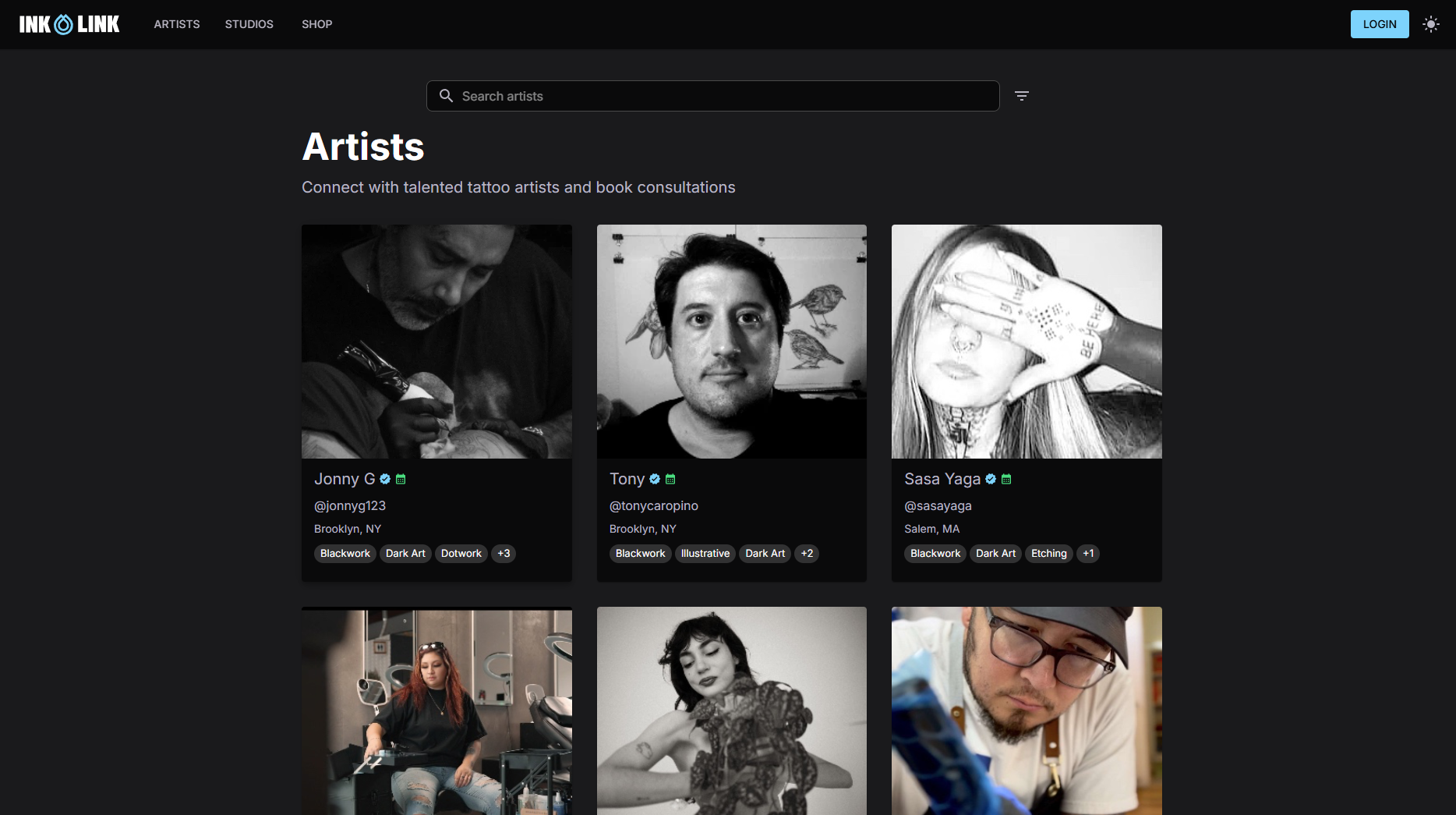
Ink link gives tattoo studios a dedicated studio booking platform that manages appointments, payments, calendars, and client records in one place. Visitors who land on your optimized site can move from browsing your portfolio to booking a session without friction. Studios on Ink link spend less time managing inquiries and more time doing the work they love. If your website is ready to convert, Ink link is ready to handle what comes next.
FAQ
What is studio website optimization?
Studio website optimization is the practice of improving your site’s speed, messaging, SEO, and user experience to convert more visitors into booked clients. It covers everything from image compression to contact form design.
How does page speed affect tattoo studio bookings?
A one-second delay in load time reduces conversions by 7%. Faster sites rank higher in search results and keep visitors engaged long enough to submit an inquiry.
What SEO keywords should a tattoo studio target?
Target long-tail, location-specific keywords like “custom blackwork tattoo artist in [city]” rather than broad terms like “tattoo.” These intent-driven phrases attract visitors who are ready to book.
How many fields should a tattoo studio contact form have?
Limit your first-contact form to three or four fields. Ask for name, email, style preference, and budget. Use conditional logic to show additional questions only when relevant.
Why does mobile design matter for a tattoo studio website?
Mobile traffic accounts for over 65% of website visits. A site that is hard to use on a phone loses the majority of its potential clients before they ever see your portfolio.