What Is a Booking Deposit? A Guide for Clients and Artists

TL;DR:
- A booking deposit is a partial upfront payment that secures a service appointment and commits clients financially. It reduces no-shows, protects income, and enables better resource planning for providers. Typical deposits range from 20 to 50 percent or a flat fee of $50 to $100 for high-value services.
A booking deposit is a partial upfront payment collected at the time of scheduling to reserve a service slot and create a financial commitment between a client and a service provider. The term “booking deposit” is the widely used everyday phrase, though service contracts and legal documents often call it a “reservation deposit” or “advance payment.” Both terms describe the same mechanism. In creative industries like tattooing, deposits are standard practice. They protect artists from wasted preparation time and give clients a confirmed spot on the calendar. The purpose of a booking deposit goes beyond simple scheduling. It filters out casual inquiries, reduces no-shows, and gives both sides a clear financial agreement before any work begins.
What is a booking deposit and how does it work?
A booking deposit is defined as a partial payment made in advance to secure a scheduled appointment or service. It is not the full price of the service. Instead, it represents a portion of the total cost, paid before the appointment date to confirm the reservation.

The deposit works as a two-sided commitment. The client pays a set amount to lock in their slot. The service provider holds that slot exclusively for that client and begins any necessary preparation. For a tattoo artist, that preparation might include designing custom artwork, ordering specific ink colors, or blocking out a full day for a large piece. The deposit compensates the artist for that work if the client cancels.
Deposits are distinct from retainers, though the two are often confused. A retainer is a recurring fee paid to keep a professional available over time, common in legal and consulting services. A booking deposit is a one-time payment tied to a specific appointment. The difference matters because retainers are typically non-refundable by nature, while deposit refund policies vary widely depending on the provider’s terms.
A security deposit, by contrast, covers potential damage or loss and is returned when no damage occurs. A booking deposit is applied toward the final service cost or forfeited if the client cancels. Knowing the difference helps clients ask the right questions before paying.
What are typical booking deposit amounts?
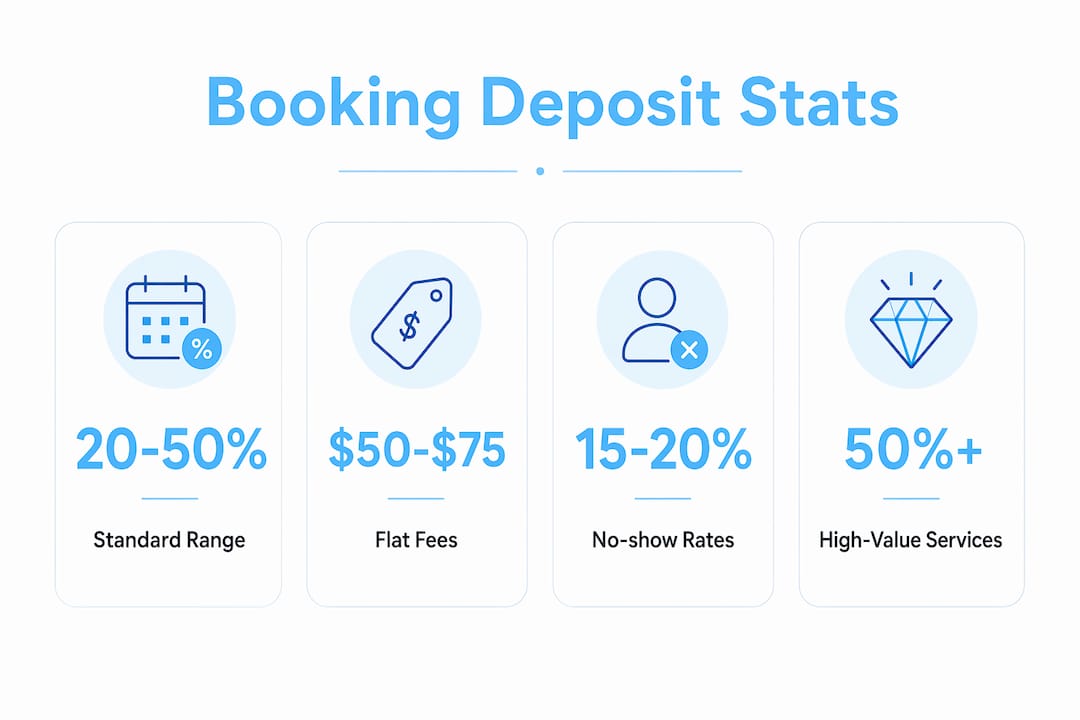
The industry standard for deposits is 20–50% of the total service cost. For high-value services priced above $500, many providers prefer a flat fee of $50–$100 instead of a percentage. That flat fee approach keeps the upfront cost predictable for clients while still creating a meaningful financial commitment.
Percentage-based deposits
Percentage-based deposits scale with the total service price. A $200 tattoo session with a 25% deposit requires a $50 upfront payment. A $600 full-day session at the same rate requires $150. This model works well for mid-range services where the percentage stays within a comfortable range for clients. The risk is that high-value services can produce deposit amounts that feel steep, which may reduce booking conversions.
Flat fee deposits
Flat fee deposits remove the scaling problem. A $75 deposit on a $1,000 custom sleeve tattoo is far more approachable than a 25% deposit of $250. The flat fee still signals commitment without creating a financial barrier. Many tattoo artists and studios use flat fees specifically for large custom projects where the design work alone justifies the upfront charge.
| Service type | Typical deposit model | Example amount |
|---|---|---|
| Standard appointment (under $300) | Percentage (20–30%) | $40–$90 |
| Mid-range service ($300–$500) | Percentage (25–50%) | $75–$250 |
| High-value service (over $500) | Flat fee | $50–$100 |
| Full-day custom session | Flat fee or percentage | $75–$150 |
Pro Tip: If you are a new artist setting deposit amounts for the first time, start with a flat fee of $50–$75 for all bookings. It is easy to communicate, easy to collect, and creates a consistent client experience while you refine your pricing.
How do deposits protect businesses from cancellations?
No-show rates can reach 15–20% during peak seasons when deposits are not required. That figure represents a significant portion of potential revenue lost to clients who simply do not show up. For a tattoo artist booked solid on a Saturday, one no-show can mean two to four hours of empty chair time with no compensation.
Deposits act as a financial safety net and a commitment device. When a client has money on the line, they are far more likely to show up, reschedule in advance, or communicate a cancellation. That behavior shift is the core value of requiring a deposit. It is not about punishing clients. It is about creating a shared stake in the appointment.
The benefits extend beyond individual appointments:
- Revenue protection: A non-refundable deposit covers at least part of the artist’s lost income when a cancellation happens with no notice.
- Resource planning: Deposits enable providers to confidently order materials, prepare custom designs, and block calendar time without financial risk from last-minute cancellations.
- Scheduling reliability: When every booked slot has a deposit attached, the calendar reflects real demand rather than wishful thinking.
- Client quality: Clients who pay deposits tend to be more serious, more prepared, and more respectful of the artist’s time.
“Deposits transform a soft verbal appointment promise into a hard financial commitment, reducing client disputes when policies are communicated clearly.” — Mews Hotel Deposit Guide
Effective deposit policies also help avoid wasted materials and labor. In tattooing specifically, an artist may spend hours on a custom stencil before the appointment day. Without a deposit, that work carries zero financial protection. A deposit policy changes that equation entirely.
What payment methods and refund policies are common?
Service providers collect deposits in two main ways: direct charges and pre-authorization holds. Each has distinct implications for clients and providers.
A direct charge moves money immediately from the client’s account to the provider’s. The deposit is collected at the time of booking and held until the appointment. If the client cancels within the allowed window, the provider issues a refund. If the client cancels outside the window or does not show up, the deposit is forfeited according to the policy terms.
A pre-authorization hold reserves funds on the client’s card without moving money. Pre-auth holds improve refund processes because no actual transfer occurs until the appointment is confirmed or the cancellation window closes. If the booking is cancelled within policy terms, funds are typically released within 3–10 business days automatically. This method is common in hospitality but is gaining traction in service-based industries.
Refund policy structures
Some businesses treat deposits as non-refundable booking fees while others apply them to the final bill. Clear terms are what determine client expectations and prevent disputes. The most common structures are:
| Policy type | How it works | Best for |
|---|---|---|
| Fully refundable with notice | Full refund if cancelled 48–72 hours in advance | New clients, lower-risk services |
| Partially refundable | 50% returned if cancelled within a set window | Mid-range services |
| Non-refundable | Deposit forfeited on any cancellation | Custom work, high-prep services |
| Applied to final bill | Deposit deducted from total at appointment | Standard practice for most studios |
Every booking deposit agreement should include four elements: the deposit amount, the cancellation window, the no-show penalty, and whether the deposit applies to the final cost. Clients who receive this information upfront are far less likely to dispute charges later.
Pro Tip: Send a written confirmation of your deposit policy immediately after a client pays. A simple email or automated receipt that restates the cancellation terms prevents misunderstandings and gives you documentation if a dispute arises.
How should clients and providers manage booking deposits?
For service providers, the first step is deciding which appointments require deposits. Starting with high-value or historically high-no-show services is the recommended approach. Piloting on select bookings lets you monitor client reactions and adjust your policy before rolling it out across all services.
Here is a practical rollout sequence for artists and studios:
- Identify high-risk bookings. Start with full-day sessions, custom design work, and any appointment that requires significant prep time. These carry the most financial risk and justify a deposit most clearly.
- Set your deposit amount. Choose a flat fee or percentage based on your service price range. Keep it consistent so clients know what to expect.
- Write your policy in plain language. State the deposit amount, when it is due, the cancellation window, and what happens if the client does not show. Avoid legal jargon.
- Choose a payment method. Use a booking platform that integrates with a payment processor like Stripe or Square. Automating deposit collection through integrated platforms significantly reduces administrative work and improves client transparency.
- Communicate before and after booking. Send the policy before the client pays and confirm receipt afterward. Repeat the key terms in your appointment reminder.
- Track deposits separately. Record deposits as advance payments, not income, until the appointment is completed. This keeps your accounting accurate and simplifies refunds if needed.
For clients, the process is straightforward. Read the deposit policy before you pay. Confirm whether the deposit applies to your final bill or is a separate booking fee. Note the cancellation window and set a reminder. If you need to reschedule, contact the provider as early as possible. Most artists and studios will apply your deposit to a new date if you give adequate notice.
Understanding your refund rights before paying protects you from surprises. A reputable provider will always share their policy upfront. If a provider cannot explain their deposit terms clearly, that is worth noting before you commit.
Implementing deposits may initially reduce overall booking volume because casual leads filter out. That is not a loss. It is a gain in appointment quality. Serious clients stay. No-shows drop. Revenue becomes more predictable.
Key takeaways
A booking deposit is the single most effective tool a service provider has for protecting revenue and ensuring clients show up prepared and committed.
| Point | Details |
|---|---|
| Standard deposit range | Industry norms set deposits at 20–50% of service cost, or a flat $50–$100 for high-value work. |
| No-show reduction | Deposits cut no-show rates significantly, which can reach 15–20% in peak seasons without them. |
| Policy clarity matters | Every deposit agreement needs a stated amount, cancellation window, no-show penalty, and refund terms. |
| Start selectively | Pilot deposits on high-risk or high-value bookings first before applying them across all services. |
| Automate collection | Using a platform with built-in payment processing reduces admin work and improves client trust. |
Deposits changed how I think about client relationships
The most common objection I hear from artists considering deposit policies is this: “I don’t want to seem like I don’t trust my clients.” That framing gets it backwards. A deposit policy is not about distrust. It is about respect for your own time and work.
I have watched artists go from dreading their Monday calendar to feeling genuinely confident about their week, simply because every booked slot had a deposit attached. The psychology shifts for both sides. The artist stops treating every booking as tentative. The client stops treating the appointment as something they can cancel at the last minute without consequence.
The mistake most providers make is going all-in immediately. They require deposits on every service, every client, every booking, and then panic when their conversion rate dips. That dip is real and temporary. The most common mistake is requiring deposits on all services at once rather than piloting on select high-risk bookings first. Start with your longest sessions and your custom work. Let clients get used to the process. Then expand.
Client education is the other half of this. When you explain why you require a deposit, most clients understand immediately. “I spend two to three hours on your custom design before you arrive. The deposit covers that work if something changes.” That sentence alone resolves most pushback. Transparency builds trust faster than any discount or exception ever will.
The long-term payoff is real. Artists who enforce clear deposit policies report better morale, more reliable income, and stronger client relationships. Clients who pay deposits show up more prepared, more excited, and more respectful of the session. A well-managed deposit policy does not just protect revenue. It sets the tone for the entire client experience.
— Matthew
Ink link makes deposit collection simple for tattoo studios
Managing deposits manually through bank transfers or cash creates confusion and leaves no paper trail. Ink link integrates with Stripe and Square so artists and studios can collect deposits automatically at the time of booking, with receipts sent to clients instantly.
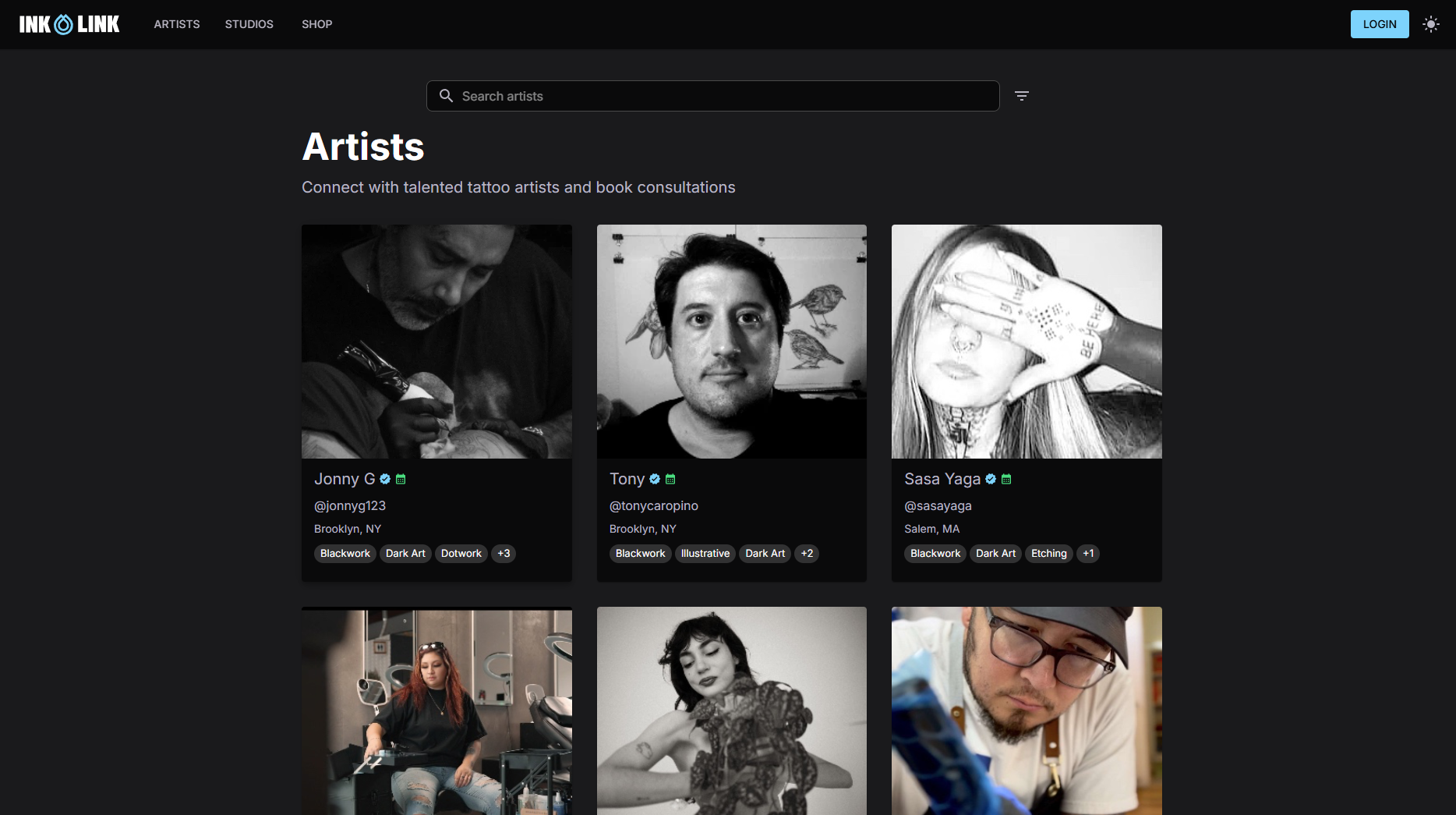
You can set flexible deposit amounts per service, whether that is a flat fee for custom work or a percentage for standard sessions. Clients see the deposit terms clearly during the booking flow, which means fewer questions and fewer disputes. Studios using Ink link’s booking platform get a complete picture of their calendar, payments, and client records in one place. Browse tattoo artists on Ink link to see how studios present their booking and deposit policies to clients in practice.
FAQ
What does a booking deposit mean?
A booking deposit is a partial upfront payment made to reserve a service appointment. It confirms the client’s commitment and compensates the provider if the client cancels without adequate notice.
Is a booking deposit refundable?
Refund terms depend on the provider’s policy. Fully refundable deposits require cancellation within a set window, often 48–72 hours. Non-refundable deposits are common for custom work where the provider invests preparation time before the appointment.
What is the difference between a deposit and a retainer?
A deposit is a one-time payment tied to a specific appointment and is often applied to the final bill. A retainer is a recurring fee paid to keep a professional available over time and is typically non-refundable by nature.
How much is a standard booking deposit?
The industry standard is 20–50% of the total service cost. For services priced above $500, many providers use a flat fee of $50–$100 to keep the upfront amount accessible for clients.
How do I pay a booking deposit?
Most service providers collect deposits through online booking platforms that integrate with payment processors like Stripe or Square. You pay by card at the time of booking, and the amount is either applied to your final bill or held according to the provider’s cancellation policy.