What Is a Blackwork Tattoo? Styles, Meaning & History
TL;DR:
- Blackwork tattoos are made with solid black ink and negative space to create bold, graphic designs rooted in ancient tribal traditions. They include styles like geometric, dotwork, neo-tribal, and blackout, each requiring specific skills and techniques. Carefully choosing a knowledgeable artist ensures a durable, visually striking tattoo that carries cultural significance.
A blackwork tattoo is a style created exclusively with black ink, relying on solid fills, high contrast, line weight, and negative space to produce bold, graphic designs without color or gray shading. The term “blackwork” functions as the recognized industry label for this approach, covering everything from geometric mandalas and dotwork to full blackout coverage. What separates blackwork from any other black ink tattoo is its design language, not just its palette. The style carries deep cultural roots stretching back thousands of years, and its modern revival has made it one of the most requested tattoo categories worldwide.
What is a blackwork tattoo, and how is it defined?
A blackwork tattoo is defined by solid black ink, high-contrast imagery, and the deliberate use of negative space rather than color or tonal shading. The skin itself becomes part of the composition. Where color tattoos use pigment to fill visual space, blackwork uses the absence of ink just as intentionally as the presence of it.
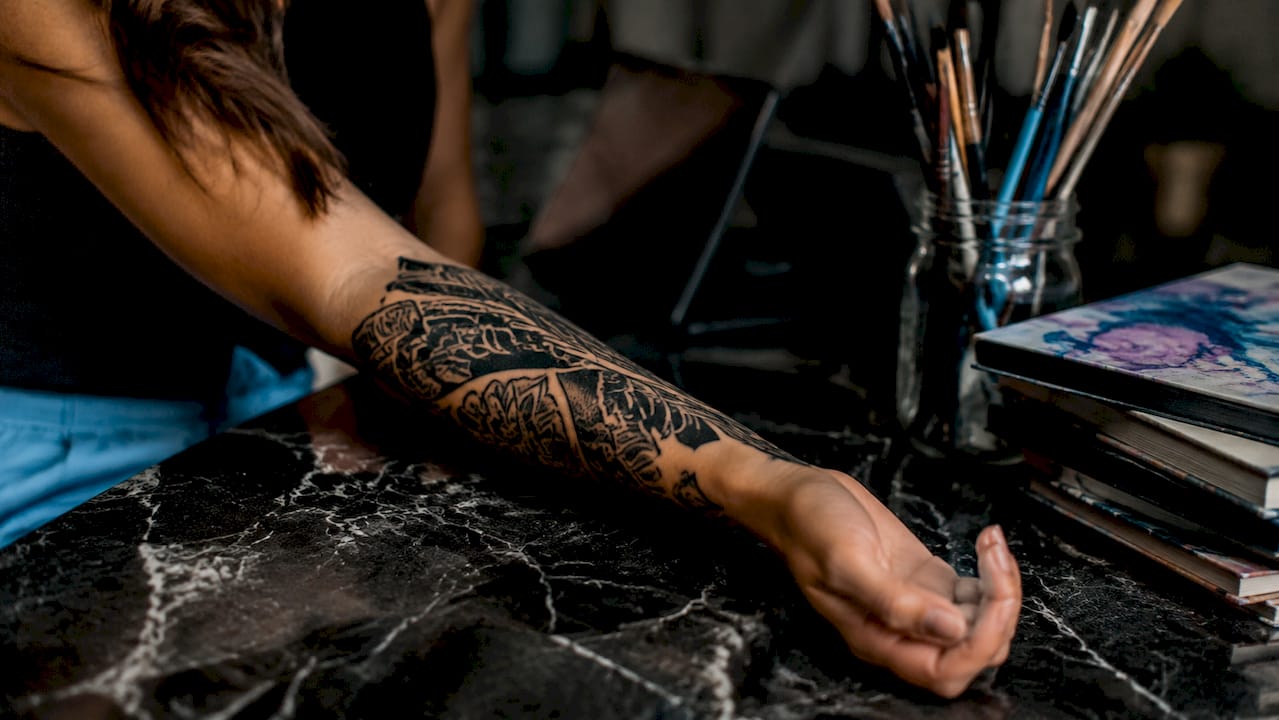
Clients commonly confuse any black ink tattoo with blackwork, but the core principle is design language, not just color. A realistic portrait rendered in black ink is not blackwork. A geometric pattern built from solid black shapes and exposed skin is. That distinction matters when you are choosing a style and searching for the right artist.
Blackwork tattoo meaning runs deeper than aesthetics. The style signals a commitment to bold, permanent visual statements. Artists working in this genre treat the body as an architectural surface, building compositions that read clearly from a distance and hold their structure over decades.
What are the main styles and techniques in blackwork tattooing?
Blackwork is not a single look. It is a family of related sub-styles, each with its own technical demands and visual character. Understanding the differences helps you find the right artist and set realistic expectations for your design.
The four primary blackwork tattoo styles are:
-
Geometric and mandala blackwork. These designs use repeating shapes, precise angles, and radial symmetry. They are among the most technically demanding styles because small symmetry deviations are immediately visible. Artists must account for body curvature, which distorts flat stencils when applied to rounded limbs or the torso.
-
Dotwork and stippling. Artists build tone and texture by placing individual dots rather than drawing continuous lines. Dense clusters create dark areas; sparse dots create lighter zones. The result is a soft, almost engraved quality that sits apart from the hard edges of traditional blackwork.
-
Neo-tribal. Inspired by Polynesian, Maori, and other indigenous traditions, neo-tribal blackwork uses bold, flowing black shapes that follow muscle groups and body contours. The designs are organic rather than geometric, and they often cover large surface areas.
-
Blackout. This style covers entire sections of skin with solid black areas, often used to conceal older tattoos. Blackout work requires precise needle depth and consistent saturation across wide areas. Any unevenness shows up as patchiness after healing.
Each style demands a different skill set. Dotwork requires patience and a steady hand for thousands of individual marks. Blackout requires technical control over ink saturation and needle depth across large zones. Geometric work requires spatial reasoning and anatomical knowledge.
Pro Tip: If you are planning a geometric blackwork piece, ask your artist to show you healed examples on body parts similar to yours. Symmetry that looks perfect on a flat stencil can shift on a curved forearm or ribcage, so experience with body anatomy is non-negotiable.
Texture and negative space are the two tools that give blackwork its dimension. Without gray wash or color gradients, artists create the illusion of depth by varying line weight, adjusting dot density, or leaving deliberate gaps of skin between solid black shapes. The interplay between ink and skin is what makes blackwork visually dynamic rather than flat.
How does blackwork differ from black-and-gray and other tattoo styles?
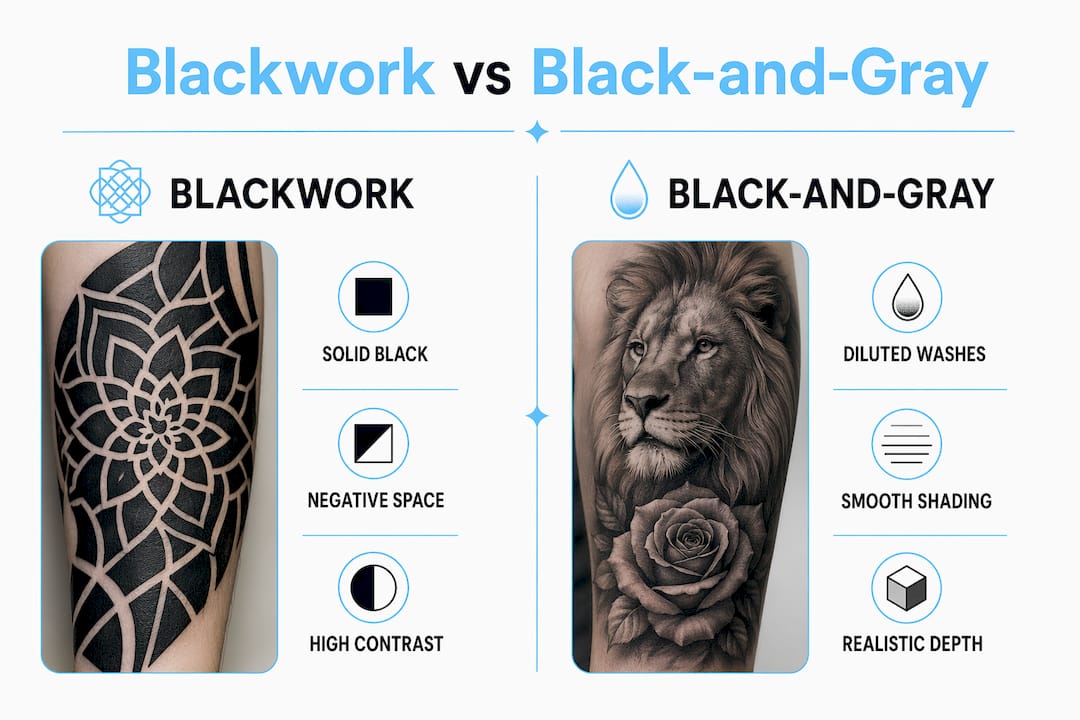
The most common point of confusion is between blackwork and black-and-gray realism. Both use black ink. Both avoid color. But their design philosophies are completely different.
Black-and-gray realism uses diluted ink washes and smooth tonal transitions to create the illusion of three-dimensional form, light, and shadow. Think photorealistic portraits or detailed nature scenes rendered in soft gradients. Blackwork, by contrast, avoids gray wash entirely. It relies on graphic shapes and solid blacks, with no attempt to mimic painterly shading.
The table below summarizes the key differences:
| Feature | Blackwork | Black-and-gray realism |
|---|---|---|
| Ink technique | Solid black fills, no gray wash | Diluted ink washes, smooth gradients |
| Design language | Graphic, geometric, high contrast | Painterly, tonal, representational |
| Negative space use | Central to the design | Minimal, used for highlights only |
| Aging behavior | Solid areas hold well; fine lines soften | Gradients can blur and lose definition |
| Common subjects | Geometry, tribal patterns, illustrative | Portraits, animals, landscapes |
| Artist skill focus | Line precision, saturation control | Shading, tonal blending |
Traditional tattooing also uses black ink heavily but pairs it with bold color fills and a specific set of classic imagery. Blackwork is not traditional tattooing, though the two share an appreciation for strong outlines and graphic clarity. Illustrative blackwork sits between the two, using detailed line drawings without color, often with a hand-drawn or woodcut quality.
Knowing these differences in blackwork tattoos saves you from booking the wrong artist. A black-and-gray specialist and a blackwork specialist have different training, different portfolios, and different strengths.
What is the historical and cultural significance of blackwork tattoos?
Blackwork tattoos trace their origins back thousands of years. The earliest blackwork tattoos used soot and plant-based inks applied with crude tools as rites of passage and symbols of protection. These were not decorative choices. They were social and spiritual acts.
The cultural traditions that shaped modern blackwork include:
-
Polynesian tattooing. Samoan pe’a and Hawaiian kakau are among the most recognized forms of traditional blackwork. These designs cover large body areas with bold black patterns that communicate genealogy, social rank, and spiritual status. The word “tattoo” itself derives from the Polynesian word “tatau.”
-
Maori ta moko. Maori facial and body tattoos use curved, spiraling black patterns called koru that are unique to each individual. Ta moko is not purely decorative. Each element encodes personal and ancestral identity.
-
Ancient Egyptian and Nubian traditions. Archaeological evidence shows black ink tattoos on mummified remains dating back over 3,000 years. These marks were associated with fertility, protection, and healing.
-
Celtic and Norse traditions. European tribal cultures used black body markings in ritual and warrior contexts, though less documentation survives compared to Pacific traditions.
The modern revival of blackwork began gaining momentum in the 1970s and 1980s alongside the broader tattoo renaissance in the United States and Europe. Artists like Cliff Raven and Leo Zulueta drew directly from Polynesian and tribal traditions to develop what became known as neo-tribal tattooing. From there, the style expanded into geometric, dotwork, and illustrative directions as a new generation of artists pushed the form.
Blackwork connects wearers to ancient body marking traditions and is chosen for its serious, timeless visual power. That connection to history is part of why blackwork carries a weight that purely decorative styles do not. When you choose blackwork, you are participating in one of the oldest forms of human expression.
The spiritual and protective symbolism historically associated with black ink tattoos has not disappeared. Many clients today choose blackwork designs with personal symbolic meaning, even when the imagery is geometric rather than traditionally tribal. The stripped-down visual language of blackwork, with no color to distract, focuses attention on form and meaning.
What should you consider before getting a blackwork tattoo?
Blackwork tattoos offer real practical advantages, but they also come with specific demands that color tattoos do not. Going in informed makes the difference between a piece you love for life and one that disappoints after healing.
Longevity is one of blackwork’s strongest selling points. Black pigment holds its appearance far longer than colored inks, which fade and shift in hue over years of sun exposure and skin cell turnover. A well-executed solid black area looks largely the same at the ten-year mark as it does at four weeks after inking. That durability is a genuine benefit for anyone committed to a bold, long-term piece.
Key considerations before booking your blackwork tattoo:
-
Artist selection matters more than in most styles. Blackwork leaves no room to hide technical errors. Patchy saturation, uneven line weight, and symmetry failures are all immediately visible. Look for artists whose portfolios show healed work, not just fresh pieces.
-
Design scale affects aging. Fine line blackwork softens faster than solid black fields over time. If longevity is a priority, designs with larger solid areas age more gracefully than intricate micro-detail work.
-
Blackout coverage requires multiple sessions. Large solid black areas cannot be completed in a single sitting without risking overworked skin. Plan for two or more sessions with healing time between them.
-
Patchy or see-through spots after healing are the most common technical failure in blackout work. They result from inconsistent needle depth or insufficient ink saturation. A touch-up session after full healing is standard practice.
-
Placement affects design integrity. High-friction areas like hands, feet, and elbows cause faster fading and require more frequent touch-ups regardless of style.
Aftercare for blackwork follows the same general principles as any tattoo: keep the area clean, moisturize with unscented lotion, avoid sun exposure during healing, and do not pick at peeling skin. For large blackout areas, your artist may recommend a specific aftercare protocol because the skin trauma from heavy saturation is greater than with lighter work.
Pro Tip: Prepare for longer sessions if your design includes large solid black areas. Heavy saturation work is physically demanding on both the skin and the artist. Eating a solid meal beforehand, staying hydrated, and scheduling breaks into your session plan will help your skin respond better and your artist maintain consistent quality throughout.
Choosing the right artist also means reviewing their portfolio specifically for healed blackwork. Fresh tattoos always look sharper than healed ones. An artist who only shows fresh work is not giving you the full picture.
Key Takeaways
Blackwork tattoos are defined by solid black ink, high contrast, and negative space, making them one of the most durable and culturally significant tattoo styles available.
| Point | Details |
|---|---|
| Core definition | Blackwork uses solid black ink, negative space, and high contrast with no gray wash or color. |
| Style variety | Sub-styles include geometric, dotwork, neo-tribal, and blackout, each with distinct techniques. |
| Historical roots | Blackwork traces back to Polynesian, Maori, and ancient tribal traditions spanning thousands of years. |
| Longevity advantage | Black pigment holds its appearance far longer than colored inks, making blackwork a durable choice. |
| Artist selection | Choose artists with healed portfolio examples, since technical errors in blackwork are immediately visible. |
Why blackwork tattoos hit differently
I have spent years watching clients walk into consultations thinking they want “something in black ink” and walk out with a completely different understanding of what blackwork actually is. The moment someone sees the difference between a gray-wash portrait and a true blackwork geometric piece, something clicks. The graphic clarity of blackwork is not subtle. It makes a statement the moment you see it.
What strikes me most is the seriousness clients bring to blackwork decisions. Clients often select blackwork for its timeless, bold aesthetic and symbolic strength. That tracks with what I observe. People choosing blackwork are rarely impulsive about it. They have thought about placement, scale, and meaning. They understand that solid black is permanent in a way that color is not, and they want that permanence.
The meditative quality of the style resonates with both artists and wearers. Clients perceive blackwork as meditative and transformative because the stripped-down visual language focuses entirely on body flow and graphic pattern. There is nothing to hide behind. The design either works or it does not. That honesty is part of the appeal.
The design challenges are real and worth respecting. Getting the negative space right, maintaining symmetry across a curved surface, and achieving consistent saturation in a large blackout area are genuinely hard problems. Artists who do this well have earned their skill. When you find one, the result is a piece that will look authoritative and intentional for the rest of your life.
— Matthew
Find your blackwork artist on Ink link
Blackwork tattooing rewards expertise. The difference between a technically skilled blackwork artist and a generalist working outside their specialty shows up immediately in the finished piece and becomes more obvious as the tattoo ages.

Ink link connects you directly with blackwork tattoo artists whose portfolios you can browse before you book. You can review healed work, compare styles across geometric, dotwork, and neo-tribal specialists, and book your consultation securely through the platform. Studios like Old Traditions Tattoo Parlor are listed with full booking availability so you can move from inspiration to appointment without the back-and-forth. Your next blackwork piece starts with finding the right artist. Ink link makes that search straightforward.
FAQ
What is a blackwork tattoo?
A blackwork tattoo is a design created exclusively with black ink using solid fills, high contrast, and negative space rather than color or gray shading. The style covers sub-genres including geometric, dotwork, neo-tribal, and blackout tattooing.
Is blackwork the same as black-and-gray tattooing?
No. Black-and-gray tattooing uses diluted ink washes and smooth tonal gradients to create realistic shading. Blackwork relies entirely on solid black shapes and exposed skin, with no gray wash involved.
How long do blackwork tattoos last?
Black pigment holds its appearance significantly longer than colored inks, with solid black areas looking largely the same at ten years as they do at four weeks after inking. Fine line blackwork softens faster than solid black fields over time.
Does blackwork hurt more than other tattoo styles?
Large blackout areas involve heavier ink saturation and longer session times, which increases physical demand on the skin. The sensation is not categorically different from other styles, but extended sessions over large areas are more taxing than smaller, lighter work.
What cultures originated blackwork tattooing?
Blackwork tattoos trace back to Polynesian, Maori, ancient Egyptian, and other indigenous traditions where black ink markings served as rites of passage, spiritual protection, and markers of social identity.