Tattoo Studio Standards: What Clients Need to Know
TL;DR:
Tattoo studio standards ensure hygiene, safety, and professionalism to protect clients and artists.
Compliance involves federal and state regulations on sterilization, waste disposal, and staff training, with proper documentation.
Tattoo studio standards are mandatory hygiene, safety, and professionalism requirements that all legitimate studios must follow to protect both clients and artists. In the United States, these standards combine federal OSHA Bloodborne Pathogen regulations with state and local body art facility rules. Together, they cover sterilization, single-use supplies, waste disposal, facility design, and client consent. Knowing what are tattoo studio standards before you book an appointment gives you real power to choose a safe, professional studio with confidence.
What are tattoo studio standards and why do they matter?
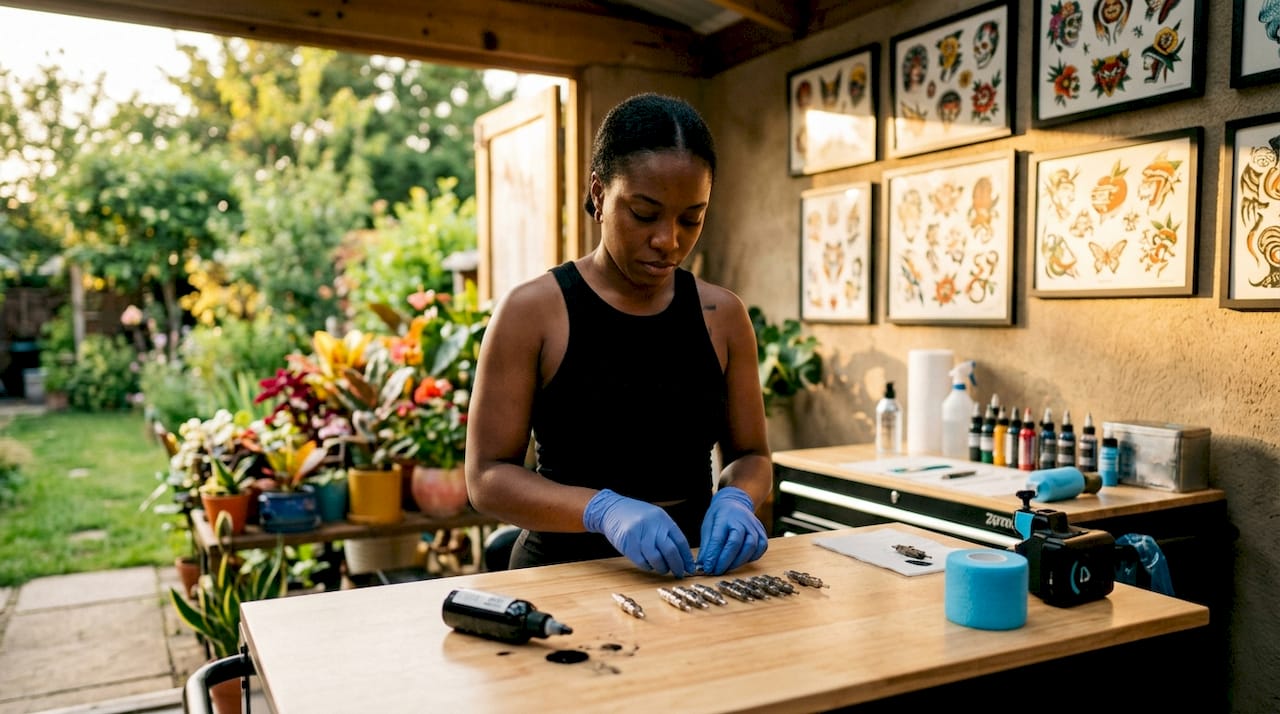
Tattoo studio standards are a defined set of hygiene, infection control, and operational protocols that govern how a studio must be set up and run. They exist because tattooing breaks the skin, which creates a direct route for bloodborne pathogens like hepatitis B, hepatitis C, and HIV to enter the body. The standards close that route through a combination of training, equipment protocols, and facility design.
The primary federal framework comes from OSHA’s Bloodborne Pathogens Standard. OSHA requires studios to maintain a written Exposure Control Plan, train all staff at initial hire and annually, offer hepatitis B vaccination at no cost, and provide personal protective equipment. That federal baseline is then layered with state and county body art regulations that add specifics around facility construction, sterilization equipment, and waste disposal.
States like Virginia and Alabama have published detailed body art programs that go well beyond the federal minimum. Alabama’s body art program issues permits, approves bloodborne pathogen training courses, and conducts ongoing local health department inspections. This two-tier system, federal rules plus state rules, is the compliance framework every legitimate studio operates within.
Understanding this framework matters for clients because it tells you exactly what to look for in a tattoo studio. A studio that meets these standards is not just clean. It is legally accountable, regularly inspected, and staffed by trained professionals.
What key hygiene and infection control practices define studio safety?
Infection control is the core of tattoo studio safety standards, and it starts before the needle ever touches skin. Virginia’s body art rules require tattoo artists to wear clean garments, perform hand hygiene before and after each client, use single-use gloves, clean the client’s skin with an approved germicide, and practice aseptic technique throughout the session. These are not optional best practices. They are legally mandated steps.
The specific hygiene requirements that define a compliant studio include:
-
Hand hygiene: Artists must wash hands with germicidal soap and dry them with single-use towels before and after every client contact.
-
Glove use: Single-use gloves are required and must be changed if torn or contaminated during a session.
-
Skin preparation: The client’s skin must be cleaned with an EPA-registered germicide before tattooing begins.
-
Aseptic technique: Artists must maintain a clear separation between clean and contaminated zones on the workstation.
-
Personal protective equipment (PPE): OSHA rules require PPE to be selected, provided, and replaced by the studio, not the individual artist.
-
Bloodborne pathogen training: All staff must complete annual training covering the Exposure Control Plan, PPE use, vaccination, and post-exposure response.
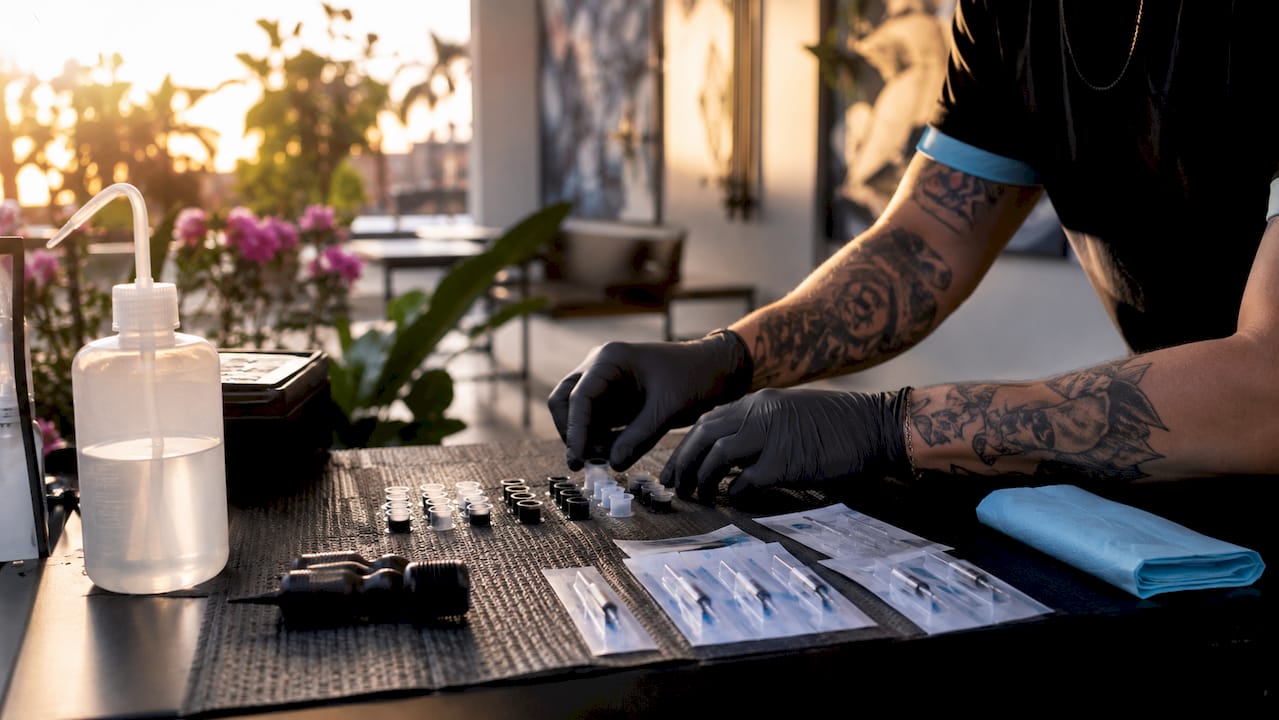
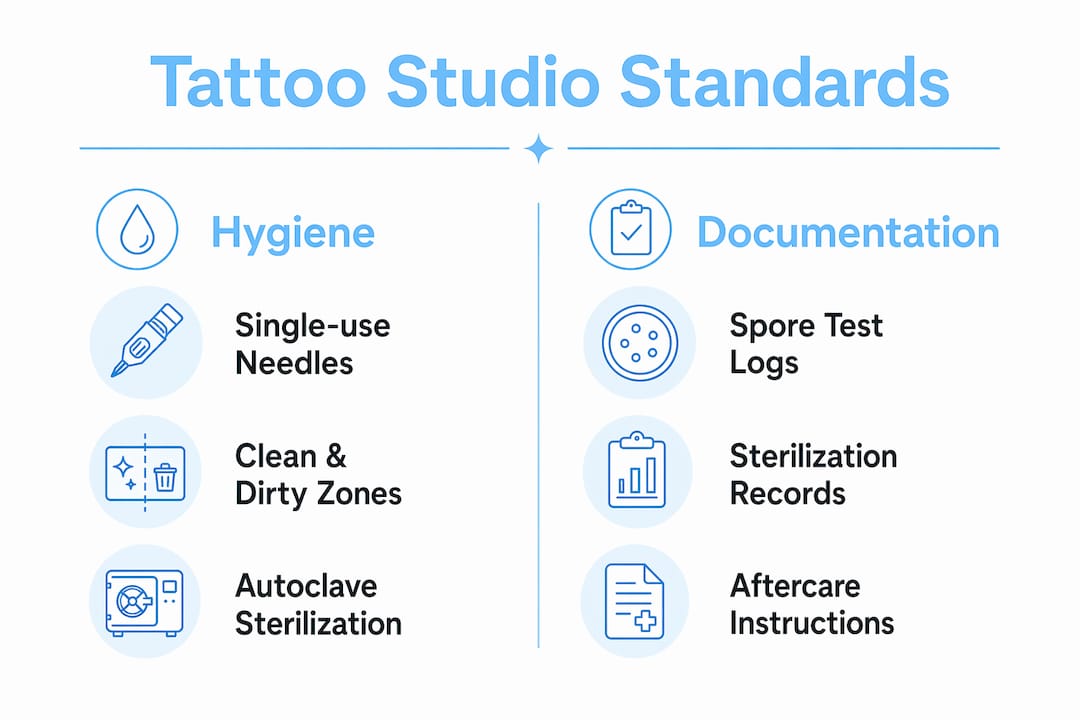
The concept of clean and dirty zones is one that many clients overlook. A trained artist keeps ink caps, the machine, and the client’s skin in the clean zone. Used supplies, waste, and anything that has touched blood stay in the dirty zone. Crossing those zones without changing gloves is a violation, and it is the kind of detail that separates a truly compliant studio from one that just looks clean.
Pro Tip: Ask your artist directly whether they use single-use needle cartridges and whether they change gloves between tasks during your session. A confident, specific answer is a good sign. Hesitation is not.
How do tattoo studios handle sterilization, equipment, and facility requirements?
Facility design and sterilization equipment are the physical backbone of tattoo shop regulations. A studio cannot pass inspection on good intentions alone. The space itself must be built and maintained to a specific standard.
Virginia’s sanitation rules require all surfaces in the tattooing area to be smooth, nonporous, and easily cleaned. Lighting must reach at least 50 foot-candles at the work surface. Hand-cleaning facilities must be present with germicidal soap and single-use towels. These requirements exist because porous surfaces like bare wood or unsealed grout harbor bacteria that disinfectants cannot fully reach.
Autoclave sterilization vs. single-use supplies
The two main approaches to instrument safety in tattoo studios are autoclave sterilization for reusable tools and single-use protocols for needles and cartridges.
| Item | Standard | Verification method |
|---|---|---|
| Tattoo needles | Single-use only, disposed after each client | Visual inspection of sealed packaging |
| Needle cartridges | Single-use only, never reused | Sealed packaging opened in front of client |
| Reusable grips and tubes | Autoclaved after each use | Sterilization pouch with chemical indicator |
| Autoclave performance | Validated by biological indicator testing | Weekly spore test logs on file |
| Work surfaces | EPA-registered hospital-grade disinfectant | Visible cleaning between clients |
The autoclave is the most critical piece of sterilization equipment in any studio that uses reusable instruments. But owning an autoclave is not enough. Biological monitoring using weekly spore tests with Geobacillus stearothermophilus is the gold standard for verifying that the autoclave is actually killing pathogens. Many jurisdictions require these tests weekly or monthly, and the results must be logged and available for inspector review.
The spore test works by placing a vial of heat-resistant bacterial spores inside the autoclave during a normal cycle. If the spores are killed, the cycle reached the correct temperature and pressure. If they survive, the autoclave is malfunctioning and all instruments processed since the last passing test must be considered unsterile.
Pro Tip: You can ask to see a studio’s most recent spore test result. A compliant studio will have a log on file. If they cannot produce one, that is a red flag worth taking seriously.
What are the regulated waste and documentation requirements in tattoo studios?
Regulated waste disposal is one of the most inspected and most frequently violated areas of tattoo studio compliance. The rules are specific, and the consequences of getting them wrong extend beyond a failed inspection.
The types of regulated waste a tattoo studio generates fall into three categories:
-
Sharps waste: Used needles, cartridges, and any other sharp objects that have contacted blood must go directly into a puncture-resistant, labeled sharps container immediately after use. Overfilled sharps containers are one of the most common violations found during inspections.
-
Biohazard waste: Blood-soaked materials like gauze, paper towels, and gloves must be placed in red biohazard bags. These bags must be properly labeled and stored in a designated area before pickup by a licensed medical waste hauler.
-
Contaminated disposables: Single-use items that have contacted the client’s skin or blood, including ink caps and plastic wrap, are treated as contaminated waste and disposed of accordingly.
Documentation is where many studios fall short. Studios frequently fail inspections not because of unsafe techniques but because of missing or incomplete records. The paperwork that inspectors look for includes:
| Document | Purpose | Retention requirement |
|---|---|---|
| Sterilization logs | Prove each autoclave cycle was run correctly | Varies by state, typically 1–3 years |
| Spore test results | Verify autoclave is functioning properly | Kept on site for inspector review |
| Waste manifests | Track regulated waste from studio to disposal | Required by state environmental agencies |
| Client consent forms | Document informed consent before tattooing | Varies by state, often 3–5 years |
| Staff training records | Confirm annual bloodborne pathogen training | Minimum 3 years under OSHA rules |
The pattern is clear. Compliance failures arise more often from incomplete documentation than from poor physical hygiene. A studio can have spotless surfaces and a functioning autoclave and still fail an inspection because the spore test log is missing two months of entries.
How do professionalism and client interactions fit into tattoo studio standards?
Professionalism is a formal part of tattoo studio requirements, not just a nice-to-have quality. Client-facing standards cover informed consent, aftercare instructions, and the personal hygiene and appearance of the artist. These elements protect both the client and the studio from legal and health risks.
Written informed consent is required before any tattooing begins. The consent form documents that the client understands the risks, confirms they are not under the influence of alcohol or drugs, and acknowledges any relevant health conditions. This document protects the studio legally and gives the client a clear record of what was agreed upon. Consent forms and aftercare documentation are treated as compliance records, not just administrative paperwork.
The professional standards that apply directly to client interactions include:
-
Aftercare instructions: Studios must provide written aftercare guidance covering wound care, signs of infection, and when to seek medical attention.
-
Artist appearance: Artists must wear clean garments during tattooing. Visible contamination on clothing is a violation in states like Virginia.
-
Client communication: Artists must explain the process, answer questions about hygiene practices, and disclose any relevant health risks before starting.
-
Refusal of service: A compliant studio will refuse to tattoo a client who appears intoxicated, has an open wound at the tattoo site, or shows signs of a skin condition that increases infection risk.
The aftercare instruction requirement is one that clients often underestimate. A studio that hands you a printed aftercare sheet is not just being thorough. It is meeting a compliance requirement that also reduces your risk of infection during the healing process. Studios that skip this step are cutting corners on both safety and legal protection.
Key Takeaways
A tattoo studio that meets U.S. hygiene and safety standards combines OSHA-mandated bloodborne pathogen training, validated autoclave sterilization, single-use needles, proper waste disposal, and complete documentation into one accountable system.
| Point | Details |
|---|---|
| Federal and state rules both apply | OSHA sets the baseline; state body art programs add facility and sterilization specifics. |
| Documentation drives compliance | Missing sterilization logs and consent forms cause more inspection failures than poor hygiene. |
| Autoclaves need proof of performance | Weekly spore tests with logged results verify that sterilization equipment actually works. |
| Single-use supplies are non-negotiable | Needles and cartridges must be opened in front of the client and disposed of after each session. |
| Client consent is a legal requirement | Written informed consent and aftercare instructions protect both the client and the studio. |
Why standards are the first question every client should ask
Most clients walk into a tattoo studio and evaluate it by how it looks. Clean floors, organized shelves, and a well-designed space feel reassuring. But the real compliance picture lives in places you cannot see at a glance: the autoclave log in the back room, the spore test results from last week, the waste manifest from the last regulated pickup.
I have spent a lot of time looking at how studios operate, and the gap between a studio that looks compliant and one that actually is compliant is wider than most clients realize. A studio can have beautiful decor and a charismatic artist and still be running an autoclave that has not been spore-tested in months. That is not a hypothetical. Inspection reports from health departments across the country show it happening regularly.
The most useful thing a client can do is ask specific questions. Not “is this place clean?” but “when was your last spore test?” and “can I see the sterilization log?” A studio that welcomes those questions is one that has nothing to hide. A studio that gets defensive or vague is telling you something important.
Clients who understand tattoo hygiene standards are also better protected during the healing process. Knowing what proper aftercare looks like, and what signs of infection to watch for, is part of the same informed approach. The standard does not end when you leave the studio.
One more thing worth saying directly: the studios that take compliance seriously tend to take their craft seriously too. The discipline required to maintain sterilization logs, run weekly spore tests, and document every client interaction is the same discipline that produces consistent, high-quality work. Standards and artistry are not in tension. They reinforce each other.
— Matthew
Find studios that take safety seriously on Ink link
Knowing what to look for is only half the equation. Finding studios that actually meet those standards is the other half.
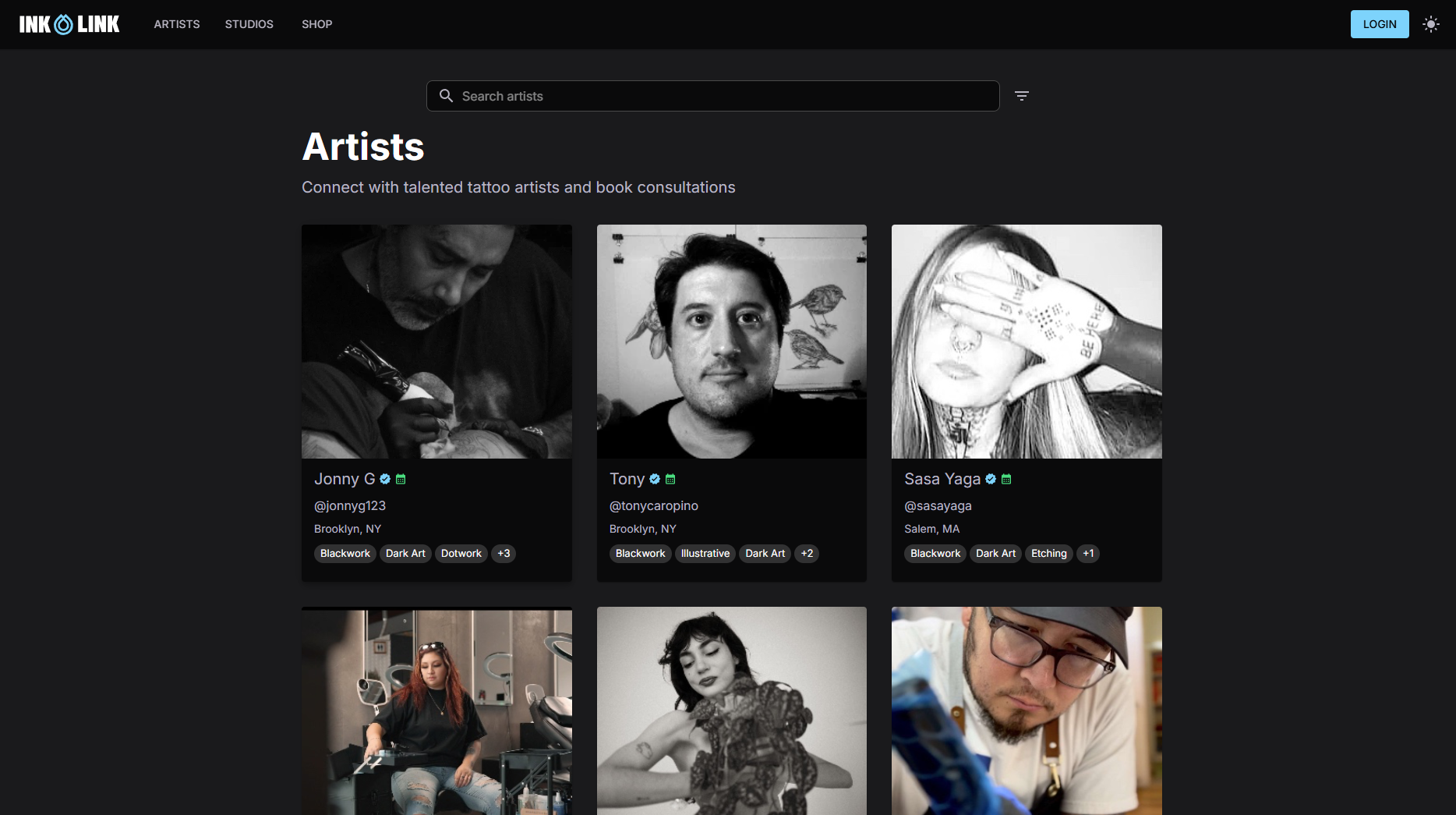
Ink link connects you with professional tattoo studios and artists who take hygiene and compliance seriously. You can browse verified studio profiles, review portfolios, and book appointments directly through the platform. Studios like Old Traditions Tattoo Parlor are listed with full profiles so you can evaluate them before you ever walk through the door. Ink link makes it straightforward to find a studio you can trust, whether you are getting your first tattoo or adding to a long-running collection.
FAQ
What are the basic tattoo studio requirements in the U.S.?
U.S. tattoo studios must comply with OSHA’s Bloodborne Pathogens Standard and state body art regulations covering sterilization, single-use supplies, facility design, waste disposal, and client consent documentation.
How do I know if a tattoo studio is properly sterilizing its equipment?
Ask to see the studio’s autoclave spore test log. Compliant studios run weekly biological indicator tests and keep results on file for health department inspectors.
What should a tattoo studio provide before and after my appointment?
A compliant studio must obtain written informed consent before tattooing and provide written aftercare instructions covering wound care and signs of infection after the session.
Why do tattoo studios fail health inspections?
Studios most often fail inspections due to missing documentation, including incomplete sterilization logs, absent spore test records, or unsigned consent forms, rather than poor physical hygiene practices.
Are single-use needles required by law?
Single-use needles and cartridges are required by body art regulations in most U.S. states. They must be opened from sealed packaging in front of the client and disposed of in a labeled sharps container immediately after use.