Tattoo pricing strategy guide for artists and studios

TL;DR:
- Pricing tattoo work requires a strategy that reflects skill level, covers costs, and attracts the right clients. Artists should choose a pricing model—hourly, per-piece, or hybrid—based on project size and complexity, and update rates annually as demand and skills grow. Clear deposit and cancellation policies protect time, while understanding size and complexity helps set fair, flexible prices; confident pricing promotes mutual respect and creative flow.
Pricing your tattoo work is one of the most frustrating parts of running a creative business. Charge too little and you’re burning through supplies, time, and energy without building real income. Charge too much without context and potential clients scroll past. A solid tattoo pricing strategy guide gives you the framework to set rates that reflect your skill, cover your real costs, and still attract the clients you actually want to work with. This guide covers every layer of the process, from choosing the right pricing model to setting deposits and knowing when it’s time to raise your rates.
Table of Contents
-
Setting deposits and cancellation policies to protect your studio’s time
-
Why confident pricing and clear policies are your studio’s best creative tools
-
Streamline booking and pricing with Ink Link’s tattoo platform
Choosing the right pricing model for your tattoo work
Every artist needs a pricing model that fits how they work. There are three main approaches in the tattoo industry, and each serves a different type of project.
Hourly pricing works best for large custom tattoos, multi-session sleeves, or anything where the scope is hard to predict upfront. You charge a set rate per hour, which protects you if a design takes longer than expected. Hourly pricing suits large multi-session projects, while per-piece pricing rewards efficiency for smaller, more predictable work. Most working artists end up using a hybrid of both.
Per-piece (flat rate) pricing fits flash designs, walk-ins, and simple tattoos where you can accurately estimate the time involved. The benefit is clear communication: the client knows the cost before they sit down, and you don’t have to watch the clock.
Hybrid pricing is what most experienced studios use in practice. Small and flash work gets a flat rate, while larger custom projects are quoted hourly or at a day rate. This gives you flexibility without sacrificing predictability.
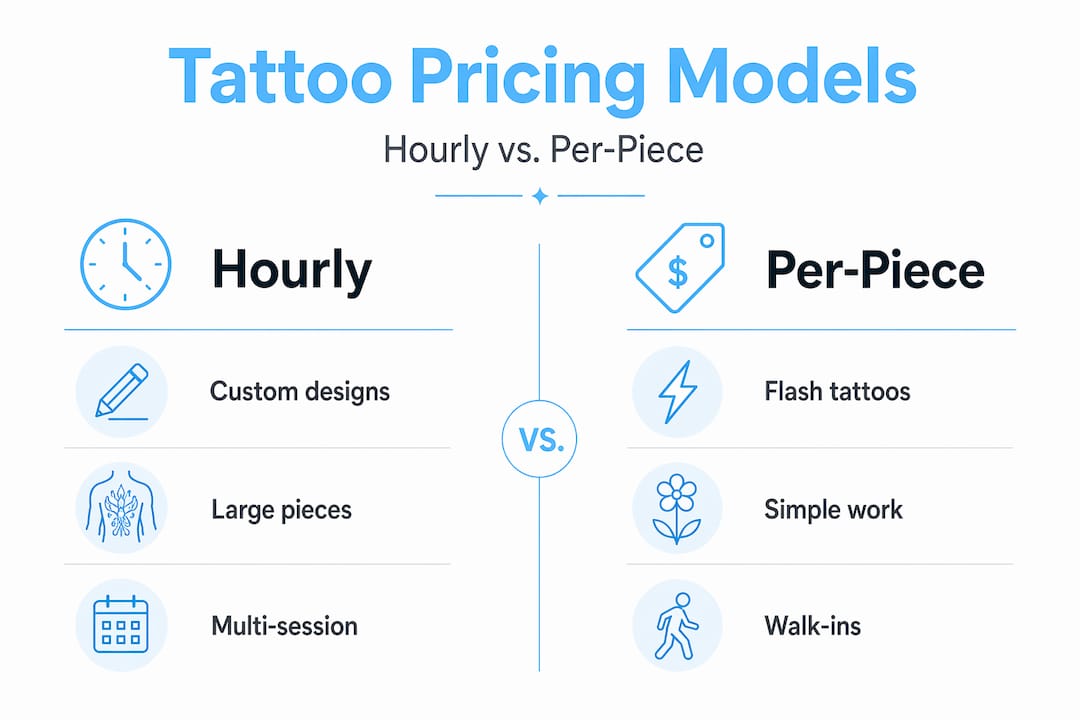
Here’s a general breakdown of tattoo pricing models by experience level:
| Experience level | Typical hourly rate |
|---|---|
| Apprentice | $60 to $100/hr |
| Mid-level artist | $100 to $150/hr |
| Experienced artist | $150 to $250/hr |
| Specialist/in-demand | $300+/hr |
-
Match your model to your work type, not just your comfort level
-
Flash and repeat designs: use flat rate
-
Custom, large-scale, or multi-session: use hourly or day rate
-
Review your model annually as your skills and demand grow
Pro Tip: If you’re moving from apprentice to independent artist, raise your hourly rate before your books fill up, not after. It’s much easier to hold a higher rate from the start than to justify an increase to existing clients.
Calculating your true tattoo hourly rate and shop minimums
Knowing your model is step one. Knowing your actual number is step two, and this is where most artists leave money on the table.
Your hourly rate needs to cover more than needle time. Hourly rates should cover preparation, supplies, overhead, and taxes, and shop minimums typically range from $80 to $150 to cover setup and materials for even the smallest appointment.
Here’s how to calculate your rate:
-
Add up all monthly fixed costs: rent or booth fee, insurance, software subscriptions, marketing, and any equipment payments
-
Add variable costs: ink, needles, disposables, gloves, wrap, and aftercare samples
-
Estimate your realistic billable hours per month, accounting for consultations, setup, and breaks
-
Divide total monthly costs by billable hours to find your break-even hourly cost
-
Add your desired income on top of that number
For example: if your total monthly costs are $2,500 and you realistically tattoo 60 hours a month, your break-even rate is about $42/hr. Add a $80/hr income goal and your minimum rate is $122/hr before taxes.
Your shop minimum is separate from your hourly rate. Setup and breakdown takes roughly 20 minutes per appointment regardless of tattoo size. That time, plus disposables and sterilization, costs real money. Understanding calculating overhead costs helps you set a minimum that ensures every appointment covers its own weight.
| Cost category | Monthly estimate |
|---|---|
| Rent / booth fee | $600 to $1,500 |
| Supplies and disposables | $200 to $400 |
| Insurance | $50 to $150 |
| Software and marketing | $50 to $200 |
| Taxes (set aside ~25–30%) | Variable |
Pro Tip: Track your actual billable hours for one full month before setting your rate. Most artists overestimate how many hours they spend tattooing vs. consulting, cleaning, and drawing.
Setting deposits and cancellation policies to protect your studio’s time
Deposits are not optional. They are the single most effective way to protect your booked time and compensate for the design work you do before a client ever sits in your chair.
Studios typically require non-refundable deposits of $100 to $200, applied toward the final cost. These deposits protect against late cancellations, no-shows, and last-minute changes. For large projects or custom work requiring multiple design hours, some artists charge higher.
Here’s what a clear deposit and cancellation policy looks like in practice:
-
Collect the deposit at booking, before any design work begins
-
Apply it to the final session price when the client shows up
-
Forfeit the deposit on no-shows, cancellations within 48 hours, or more than one reschedule
-
Require a new deposit if a client reschedules more than once
A client who puts money down is a client who shows up. Deposits filter out casual inquiries and protect you from spending hours on a custom design for someone who never commits.
Key points to include in your written policy:
-
Deposit amount and how it applies to the final price
-
Minimum notice required for rescheduling without penalty
-
What happens to the deposit on a no-show
-
How to reschedule and whether multiple changes are allowed
Managing deposit and cancellation policies transparently at booking avoids confusion later. Put your policy in writing, share it at every booking, and don’t make exceptions that undermine it.
Pro Tip: Add your cancellation policy to your booking confirmation message automatically. Clients who see it twice, once when booking and once in their confirmation, almost never claim they didn’t know.
Pricing tattoos by size and complexity: practical examples
Size matters, but it doesn’t tell the whole story. A 3-inch traditional rose takes far less time than a 3-inch photorealistic portrait. Your tattoo price guide needs to account for both dimensions.
Use size as your starting anchor, then adjust upward for complexity, style, color, and placement. Size price bands for 2026 look roughly like this:
| Tattoo size | Typical price range |
|---|---|
| Tiny (under 2 inches) | $50 to $150 |
| Small (2 to 4 inches) | $100 to $300 |
| Medium (4 to 6 inches) | $250 to $600 |
| Large (6+ inches) | $500 to $1,200+ |
| Sleeve / XL piece | $1,000 to $4,000+ |
Tiny tattoos almost always hit the shop minimum because setup costs don’t scale with size. See tattoo size and pricing guide for more detail on how to structure your own bands.
Complexity adjustments to factor in:
-
Realism or fine line: Add 20 to 40% over standard rate due to technique intensity
-
Full color vs. black and gray: Color work typically takes longer; price accordingly
-
Cover-up tattoos: Almost always quote higher due to design constraints
-
Difficult placements like ribs, hands, or necks: Expect slower work, quote for it
-
Flash designs: Flat rate is fine since the time is predictable
Pro Tip: Always give a price range, not a single number, for custom quotes. “This will be between $400 and $550 depending on final size and session length” sets honest expectations and protects you if the piece runs long.
Avoiding common pricing mistakes and when to raise rates
Most pricing problems aren’t about what to charge. They’re about what artists forget to include.
Charging only for needle time is the most common error. Consultations, design revisions, setup, and breakdown all cost time. Undervaluing work by charging only for needle time leads to losses. Artists should raise prices when bookings fill consistently, skills improve, or costs increase. A 10 to 15% annual increase is sustainable and expected.
Common mistakes to avoid:
-
Discounting for friends or repeat clients without a clear policy
-
Failing to adjust rates after completing additional training or certifications
-
Ignoring rising supply costs when they eat into your margin
-
Keeping prices flat for years because raising them feels awkward
Artists who price confidently and fill chairs efficiently thrive financially, not necessarily the most talented ones.
When to raise your rates:
-
Your books fill more than three weeks out consistently
-
You’ve improved your skills or expanded your style range
-
Your overhead has increased, including rent, supplies, or software
-
You haven’t reviewed your pricing in over 12 months
Higher prices often attract better clients. Someone who pays $500 for a medium tattoo without complaint is more likely to respect your time, show up on schedule, and tip than someone who negotiated you down from $300.
Why confident pricing and clear policies are your studio’s best creative tools
Here’s something most pricing guides skip: pricing is not just math. It’s communication.
Every rate you set, every deposit you collect, and every policy you enforce sends a message about how you value your work. Artists who hesitate to charge what they’re worth often find themselves overbooked, underpaid, and creatively drained. Artists who price confidently and fill chairs efficiently build the kind of practice where they can afford to be selective about projects.
Clear policies create something else that’s easy to overlook: mutual respect. When a client knows exactly what they’re paying, what happens if they cancel, and what the deposit covers, there’s no room for the awkward conversation later. That clarity is worth a lot more than any discount you might offer to “keep the peace.”
There’s also a creative benefit to confident pricing that doesn’t get talked about enough. When you’re not quietly anxious about whether you’re charging enough, you do better work. Financial stress and creative flow don’t mix well. Building a tattoo pricing guide that reflects your real costs and goals frees you to focus on what actually matters: the art.
Pricing evolves. What worked for you as an apprentice won’t serve you as an established artist with a waiting list. Review your rates, your model, and your policies at least once a year. The artists who thrive long-term are the ones who treat pricing as part of their craft, not an afterthought.
Streamline booking and pricing with Ink Link’s tattoo platform
Putting these pricing strategies into practice is a lot easier when your booking system works with you, not against you.
Ink Link is built specifically for tattoo artists and studios. You can display your rates and minimums directly on your profile, automate deposit collection at booking, and manage your calendar and client records all in one place. No more chasing deposits over text or manually tracking who canceled. See how studios like Old Traditions Tattoo Parlor use the platform to run smoother operations and protect their time. Ready to put your pricing to work? Explore tattoo pricing management tools on Ink Link and discover studios already using the platform to build profitable, client-friendly businesses.
Frequently asked questions
What is the difference between hourly and per-piece tattoo pricing?
Hourly pricing charges based on tattooing time and suits large, multi-session projects with unpredictable scope. Per-piece pricing is a flat fee for simpler tattoos where experienced artists use per-piece pricing for efficiency and hourly for larger, uncertain work.
Why do tattoo studios require a minimum charge?
Minimum charges cover fixed costs like setup, sterilization, and disposable supplies that don’t decrease with smaller tattoos. Shop minimum typically ranges $80 to $150 to cover overhead regardless of tattoo size.
How do tattoo deposits work?
Deposits are non-refundable fees, typically $100 to $200, paid upfront to secure an appointment. Non-refundable deposits apply to the final price but are forfeited if the client cancels late or doesn’t show.
When should tattoo artists raise their prices?
Artists should raise prices when they’re consistently booked out weeks in advance, have improved their skills, or haven’t adjusted rates in over a year. Price increases of 10 to 15% yearly are sustainable and reflect growing expertise and rising costs.