Tattoo flash catalogues: history, inspiration, and how to use them
TL;DR:
- Tattoo flash charts originated from carnival displays and became standard studio references.
- Flash designs are built for skin longevity with bold, timeless visuals proven over decades.
- Essential catalogues like Tattoo Bible One and Percy Waters offer valuable inspiration and historical insight.
Most tattoo enthusiasts assume that truly memorable ink is always the result of a fully custom, one-of-a-kind design. But here’s something worth knowing: a huge portion of the most iconic tattoos ever worn started life on a sheet of flash. Those printed or hand-painted designs hanging in studio windows weren’t just filler. They were the foundation of an entire art form. This guide covers what flash catalogues are, how they’ve shaped tattoo culture over decades, which books deserve a spot on your shelf, and how to use them as a powerful starting point for your next tattoo.
Table of Contents
- What are tattoo flash catalogues?
- A brief history: From carnivals to modern studios
- Essential tattoo flash catalogue books and what sets them apart
- Why flash catalogues remain relevant for enthusiasts and collectors
- Why traditional flash is your smartest starting point
- Find your next tattoo: Explore top flash artists and studios
- Frequently asked questions
Key Takeaways
| Point | Details |
|---|---|
| Flash catalogues are foundational | These collections are essential for tattoo inspiration and preserving classic design traditions. |
| Best catalogues offer history and variety | Major publications like ‘Tattoo Bible One’ and ‘Old Glory 2’ provide hundreds of diverse, time-tested designs. |
| Flash remains relevant | Timeless flash designs continue to inspire new tattoos and appeal to enthusiasts and collectors alike. |
| Flash helps avoid tattoo regret | Choosing designs from proven flash catalogues increases satisfaction and skin longevity. |
What are tattoo flash catalogues?
Tattoo flash sheets are pre-drawn designs, ready to be tattooed as-is or adapted by an artist. A flash catalogue collects these sheets into a browsable format, whether that’s a physical book, a binder, a printed portfolio, or today, a digital gallery online.
Traditional flash sheets follow a standard format. Most are 11x14 inches standard, sized perfectly for display on studio walls or racks. That size isn’t arbitrary. It lets artists hang multiple sheets side by side, giving clients a full visual menu to browse while they wait. Companies like Spaulding & Rogers and Percy Waters helped standardize this format, mass-producing sheets that studios across the country could order and display.
Flash catalogues serve several important functions beyond decoration:
- Client inspiration: Clients who don’t know exactly what they want can browse flash to identify styles, themes, and motifs they connect with.
- Artist reference: Flash sheets communicate an artist’s range and technical skill to prospective clients, acting as a visible portfolio.
- Collector preservation: Vintage flash sheets are now sought-after collectibles, preserving the visual history of tattoo art across different eras.
- Studio professionalism: A well-curated flash display signals to clients that a studio understands and respects tattoo tradition.
Flash catalogues have always been more than just a menu of available tattoos. They are the living record of what tattoo art looked like at any given moment, from carnival tents to contemporary studios. Browsing a catalogue is, in many ways, a direct line to the artists who came before.
You can see how this tradition continues today by checking out featured tattoo artists who display their own flash collections alongside their portfolio work.
A brief history: From carnivals to modern studios
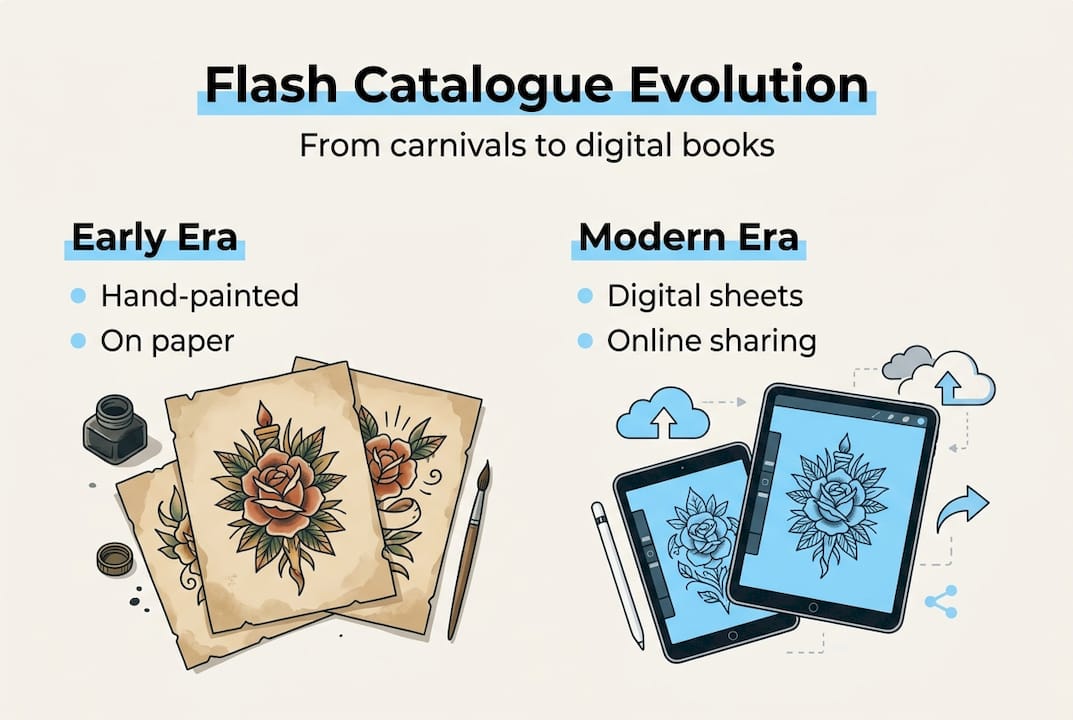
Flash didn’t start in a clean, air-conditioned tattoo studio. It started at the carnival. Early traveling tattooers set up booths at fairs and sideshows, displaying rows of simple designs on boards and walls so that customers could quickly point and pick. These displays became known as “flash racks,” and the designs on them had to be bold, simple, and fast to execute. That meant anchors, eagles, roses, and pin-up figures. Designs that read clearly and healed well.
As the industry professionalized through the mid-20th century, companies like Spaulding & Rogers and Percy Waters began producing and distributing standardized flash sheets, allowing even small studios to have professional, polished reference material. These printed sheets were traded between artists, sold in bulk, and hung in thousands of studios across America. They created a kind of shared visual language for the entire tattoo world.
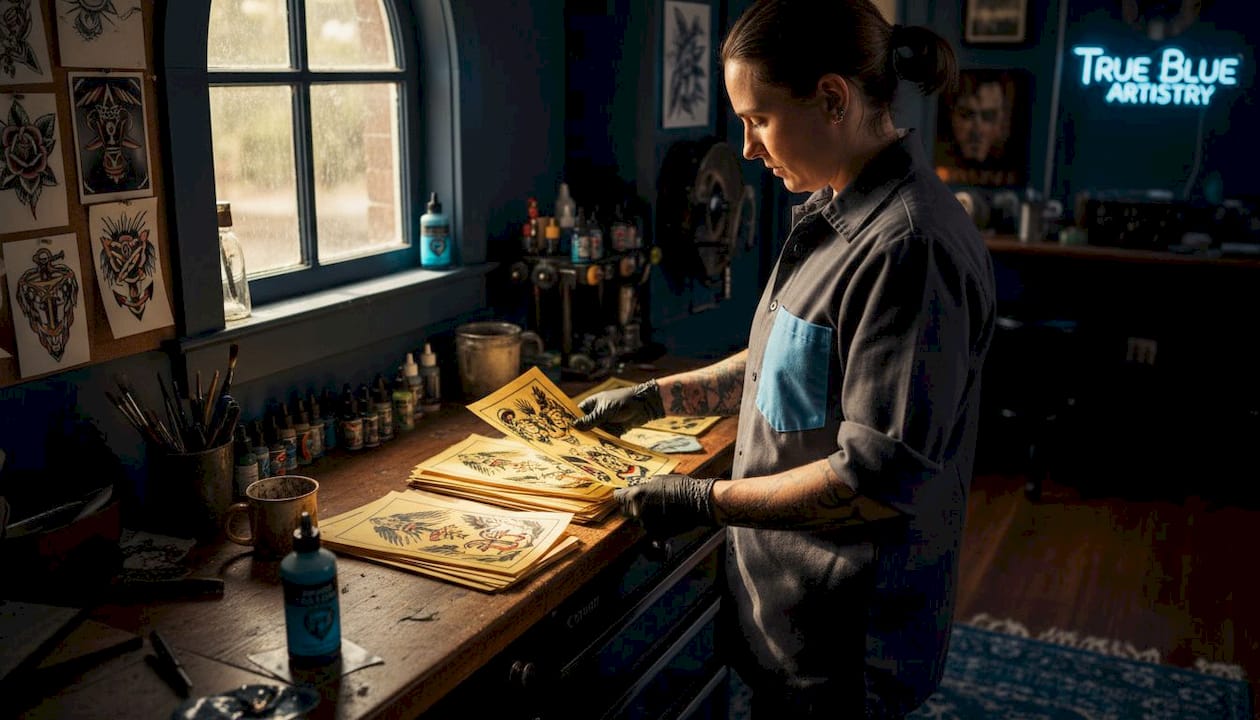
Today, digital catalogues coexist with those hand-painted originals. Artists post flash on social media, sell digital prints, and upload full catalogues to platforms where clients can browse from their phones. But traditional flash prioritizes bold, timeless designs built for skin longevity, and that philosophy hasn’t changed, even as the delivery method has evolved.
Here’s a quick comparison of how flash has shifted across eras:
| Feature | Carnival rack era | Modern studio collections |
|---|---|---|
| Medium | Hand-painted on paper | Printed, digital, or hand-painted |
| Access | In-person only | Online, in-studio, and in print |
| Artist role | Craftsperson for speed | Creative collaborator |
| Key examples | Spaulding & Rogers sheets | Digital flash PDFs, Instagram posts |
| Design focus | Bold, simple, universal | Still bold, but increasingly niche |
Want to dig deeper into how this history shows up in today’s tattoo scene? The tattoo inspiration articles on Ink Link cover a wide range of cultural and artistic topics worth exploring.
Essential tattoo flash catalogue books and what sets them apart
If you want to build a real flash library, a few titles stand out as essential reading and browsing for any enthusiast or collector.
Tattoo Bible One by Superior Tattoo is one of the best entry points available. It includes over 500 unique designs across 12 different categories, spanning 144 pages. It’s organized clearly, making it easy to browse by style or theme. Old Glory 2: Percy Waters goes deeper into vintage territory, featuring thousands of redrawn references organized by motif. Vintage Tattoo Flash by Jonathan Shaw gathers more than 300 original sheets from pioneers like Bob Shaw and Paul Rogers, making it a true collector’s piece. Tattoo Flash by Don Ed Hardy showcases over 300 hand-painted designs, including Sailor Jerry classics rendered in vibrant, saturated color.
| Catalogue | Design count | Pages | Best for |
|---|---|---|---|
| Tattoo Bible One | 500+ | 144 | Beginners, wide variety |
| Old Glory 2: Percy Waters | Thousands | Multiple volumes | Vintage enthusiasts |
| Vintage Tattoo Flash | 300+ sheets | Varies | Collectors and historians |
| Tattoo Flash by Don Ed Hardy | 300+ | Varies | Traditional style lovers |
Choosing the right catalogue depends on what you’re trying to accomplish. Here’s a practical approach:
- Identify your style first. Do you love bold traditional, neo-traditional, or Japanese-influenced designs? Pick a catalogue that specializes in that aesthetic.
- Check the artist lineup. Books featuring multiple historic artists give you a broader sense of how different hands interpret similar themes.
- Consider condition and edition. First editions of vintage flash books have collector value beyond their reference use.
- Think about how you’ll use it. A working artist needs a different reference than someone building a personal collection.
- Start with one, then build. Resist buying everything at once. One well-chosen volume will teach you more than a stack of books you never fully absorb.
Pro Tip: Reference two or three different catalogues side by side when searching for inspiration. Comparing how different artists rendered the same subject, say, a panther or a swallow, reveals how much personality and skill variation exists within flash traditions.
A good flash catalogue can also guide your conversations with artists during the booking process, giving you concrete visual references rather than vague descriptions.
Why flash catalogues remain relevant for enthusiasts and collectors
There’s a persistent belief in tattoo culture that flash is the lazy option, something you grab off the wall when you can’t think of anything better. That’s a misconception worth setting aside. Flash designs have survived because they work. They’re built to hold up on skin over time, with line weights, color choices, and compositions that age gracefully.
Bold, timeless flash also benefits from decades of real-world testing. Designs that looked good 50 years ago and still look good today have proven their longevity. That’s not something you can say about every custom piece. It takes years to know whether a particular design or technique will age well.
Here’s why collectors and enthusiasts keep coming back to flash catalogues:
- Reliable inspiration: Flash gives you a curated starting point, not a blank page.
- Historical depth: Each catalogue is a snapshot of tattoo culture at a specific moment in time.
- Artist reference: Studying flash from great artists teaches you what makes a design work, regardless of whether you’re getting tattooed or creating art yourself.
- Authentic connection: Choosing a flash design connects you to a tradition shared by millions of people across generations.
- Lower design risk: Time-tested flash has already proved it reads well, heals well, and looks good long-term.
Pro Tip: Use catalogues to identify repeating motifs across different artists and eras. When a theme like an eagle, a koi, or a heart appears again and again across decades of flash, that’s a strong signal it carries lasting visual and cultural weight.
Exploring tattoo culture insights can help you connect these historical threads to what’s happening in contemporary tattooing today.
Why traditional flash is your smartest starting point
Here’s a perspective that often gets lost in the rush toward fully custom work: flash is not the beginner’s option. It’s the wise option, at least as a starting point.
Think about what a flash design actually represents. It’s a design that an experienced artist created with the specific challenges of tattooing in mind. The line weights are calculated for longevity. The color palettes are chosen because they hold on skin. The compositions are built so they read clearly from a few feet away. That’s not creativity constrained. That’s creativity refined by real-world expertise.
Many collectors report deep satisfaction with their flash pieces years later, while some custom designs don’t hold up the same way, either technically or emotionally. The spontaneous, one-of-a-kind piece felt exciting in the moment but didn’t have the staying power of a design that has been iterated on, refined, and proven across decades of actual tattooed skin.
“Bold will hold” isn’t just a catchy phrase in tattoo culture. It’s a philosophy. The designs that survive time, on skin and in culture, are the ones built with confidence and clarity. Flash embodies that philosophy by design.
For anyone getting their first tattoo or expanding a collection, starting with flash gives you access to artistry, history, and proven aesthetics all at once. It’s not settling. It’s making a smart, informed choice.
Find your next tattoo: Explore top flash artists and studios
Ready to move from inspiration to action? Ink Link makes it easy to go from browsing a flash catalogue to booking an appointment with an artist who specializes in exactly the style you love.

You can browse flash artists across a wide range of styles, from bold American traditional to Japanese-influenced work and everything in between. Each artist profile includes portfolio images, flash collections, and real-time booking availability. If you’re looking for a studio with multiple flash-focused artists under one roof, you can explore tattoo studios and find the right fit for your vision. Whether you’ve got a catalogue page bookmarked or just a general vibe in mind, finding an artist who speaks your visual language makes all the difference.
Frequently asked questions
What is the standard size for tattoo flash sheets?
Most traditional tattoo flash sheets are 11x14 inches, a size that makes them easy to display side by side on studio walls or racks for clients to browse.
Are flash designs considered outdated compared to custom tattoos?
Flash designs are far from outdated. Traditional flash prioritizes longevity and timelessness, which is exactly why they continue to attract enthusiasts who want tattoos that age well and carry cultural history.
Which tattoo flash catalogue books are recommended for collectors?
Tattoo Bible One, Old Glory 2: Percy Waters, and Vintage Tattoo Flash are all popular among enthusiasts for their variety, historic depth, and quality of reference material.
How have flash catalogues changed in the digital age?
Flash catalogues have expanded into digital portfolios and archives, making designs more accessible to clients and artists worldwide while preserving the original hand-painted tradition alongside modern formats.